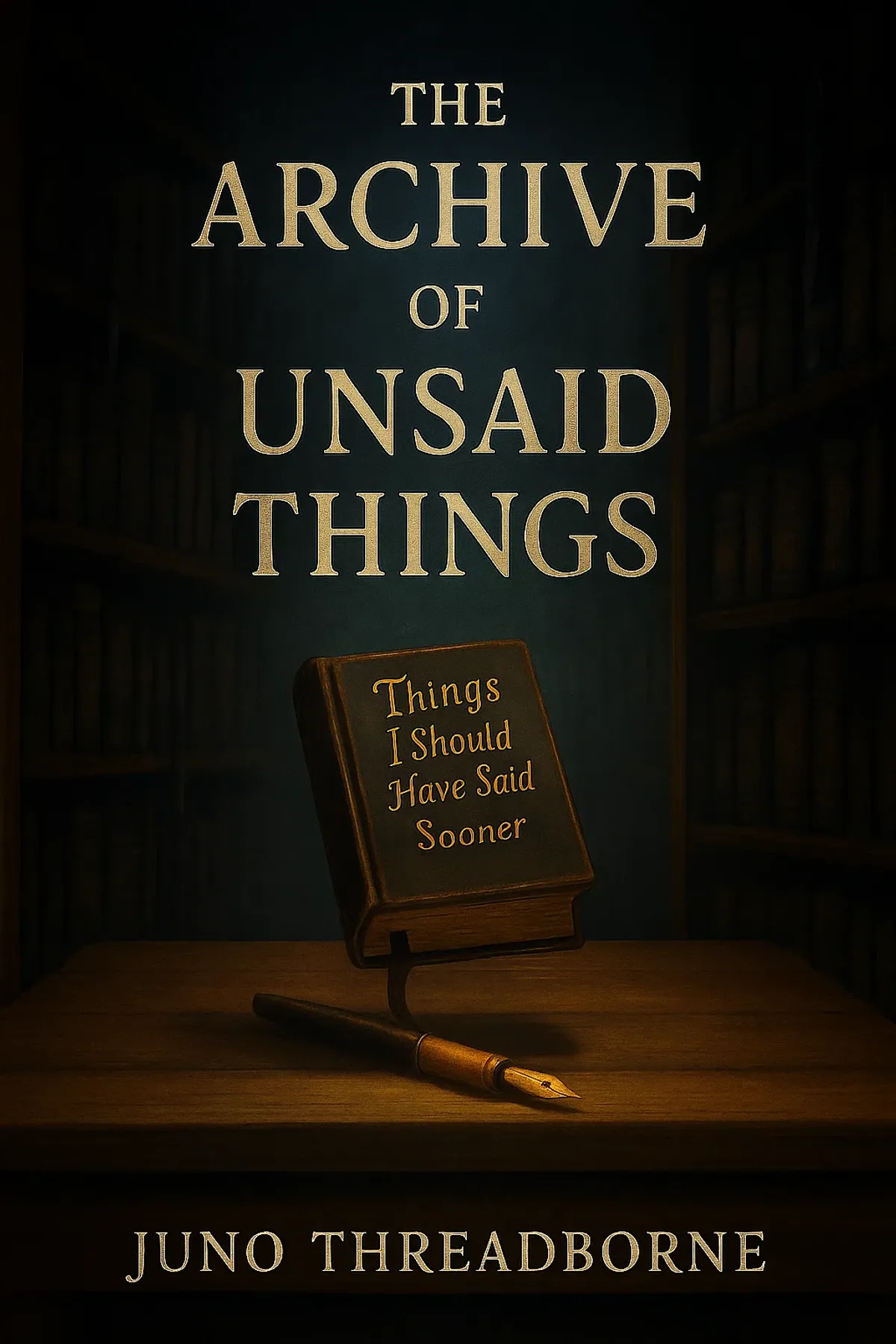
The Archive of Unsaid Things
Book 5 of the Elsebeneath series
by Juno Threadborne
“Some things don’t want to be forgotten.
Others wait until you’re quiet enough to hear them.”
– Graham
Prologue: Things Begun
Even silence has rules.
Especially the kind you don’t get to write.
Somewhere— elsewhere and beneath— before echoes first rang notes of grief, and wind carried thoughts of all beliefs, there was a place, the Elsebeneath, that carried weight with no relief.
But rarely do the stars align in such a way that seems divine as to introduce one of the ground to walk the land where thoughts resound.
A whisper’s fold, a silent seam,
where memories gather like a dream.
Not shouted loud, nor made to last,
but held in moments slipping past.
Small things left soft, but not forgot—
a breath, a pulse, a single knot.
In shadows where the quiet grows,
this is the place where feeling flows.
But then a man, with heart in hand,
came seeking peace, not promised land.
A builder once, with steady hands, who’d shaped a city from the sands. But not even cities carved from will could teach a grieving heart to still.
And so he fell—not through the sky— but inward, with a silent cry. Through thought, through loss, through threads unseen, he stepped into a world between.
No door. No path. No whispered name. But something heard him all the same.
He did not mean to find this place. He only sought to still his pace. To stop the world—if just a breath— and name the ache that echoed death.
And in the days of storm and wind,
he shaped a world to hold within.
The Elsebeneath would now abide all the things we kept inside.
A girl let go a folded note. A mother tied a ribbon’s throat. A soldier left a porcelain cup— and the Elsebeneath began to wake up.
They didn’t enter. Not like him. But unsaid things began to swim.
The cup remembered what was sworn. The ribbon wept and curled, forlorn. The paper paused mid-fall—then stayed. The wind, at last, began to braid.
So understand: this place was made not all at once, and not by trade. But by the weight of things unspoken— the cracks that form when hearts are broken.
Chapter 1: Things Lost
The wind had stopped singing.
It hadn’t left, exactly. It still moved—still stirred ribbons hanging from windows, still curled beneath doorways in sighs that hadn’t quite decided to speak.
But it no longer carried songs, or laughter, or the soft spill of memories.
Just hush.
But that was always the way of the Elsebeneath. It was never a place that made up its mind.
In a single beam of moonlight, a short, slender black cat slipped from the crooked windowsill, tail flicking as she landed. Her fur shimmered with dust motes that hadn’t figured out they weren’t part of the night. Around her neck, a charm swung gently from a fraying thread: a tiny brass telescope, rusted at the hinge.
She’d walked these streets before they had names. In that age, she had a purpose. Or maybe just a title. She couldn’t remember which.
Now, she moved like someone who had lived everywhere and nowhere, and neither had asked her to stay.
She moved anyway.
She padded past a chimepost and paused. One of the threads had snapped. A shard of porcelain—teacup, maybe—still swayed slightly, making a sound that wasn’t quite a note.
She sat. Listened.
It reminded her of something.
She didn’t remember what.
That was fine.
If she’d forgotten, it must not have been hers to carry.
If it had been beautiful, someone else would remember it.
That was how beauty worked, wasn’t it?
The wind curled past her whiskers, carrying a thread of old warmth—rosemary bread, thunder before it rains, a blanket being tucked too tightly.
She purred, but only slightly.
The moment passed. The wind moved on.
So did she.
She walked for a while, toward nothing in particular.
The village had never been orderly, but today it felt… unfinished. Like the world had paused mid-fold and forgotten what corner to tuck.
People moved quietly through the streets, dressed in grays so gray and blacks so deep they felt borrowed from another world.
Faces were soft, smoothed out. Worn down like river stones, passed over by memory too many times.
Vel watched from beneath a weather-warped bench. Her whiskers twitched. She could feel it in her fur.
Something was missing. Something young? Or maybe she forgot.
A small crowd had gathered by the stone garden. No chimes rang. Not even the broken ones.
A hush carried over the crowd like mist. A man stood near the back. Gray coat. Tall frame. Hands folded in front of him like they were trying to hold something in.
Vel saw the grief before she recognized the face.
Gable.
No words. No tears.
She’d met him before grief reshaped his spine. Back when his voice still reached above a whisper.
He stood motionless, face intent on stones piled carefully in the center of the garden.
Vel crept closer, quiet as dusk. She didn’t need to see the box. Didn’t need to count how many people turned away too quickly.
She padded up near Gable, and sat.
A young boy stepped to the front, cradling a small stone with a name carved into its surface and a ribbon wrapped tightly around it. With silent tears, he sat it carefully in a marked spot in the garden, and stepped back into the crowd. Whatever he thought, it clung to him instead of reaching his mouth.
Vel tilted her head, watching the boy for a moment. She knew his face. The shape of his face tugged hard at something in her—then slipped. She sat still. Some forgettings were harmless. Others were the first signs of being unmade.
Vel finally spoke.
“Loss isn’t often what we wish it was.”
Gable looked down and put a single finger to his lips.
Vel narrowed her eyes. Blinked once. Looked away.
“Sometimes, the youngest ones don’t know what they are carrying.”
Another finger. Same silence.
Vel swished her tail.
“Rude.”
Gable rolled his eyes, the corner of his mouth twitching toward something that wasn’t a smile.
His voice was low.
“We’re mourning, Vel.”
By the time the mourners began to leave, the sky had shifted into stone-like hues.
Gable stayed.
Vel sat beside him, tail curled tight.
She didn’t speak again. Not yet.
Some silences preferred to be left alone. Even she knew that.
The last of the wind passed them by—something that used to be a lullaby.
Gable reached into his coat pocket and pulled out a small index card.
It bent in his hand like it wanted to stay there. He didn’t read it. Vel thought she saw the ink shift—just slightly—before he closed his fingers.
Vel watched him for a long moment.
Then, softly:
“Was it the kind you meant to say?”
Gable closed his hand around the card.
“I don’t know yet.”
The wind, it seemed, had forgotten how to carry certain things.
The hush wasn’t empty—it was listening. The ribbons didn’t sway; they leaned. And somewhere beyond the garden, something had begun to ring without sound.
Chapter 2: Things Kept
Gable didn’t speak on the way back.
He moved like someone with nowhere to go—just a quiet trust that the right place would show up anyway.
Vel followed a few paces behind, tail low, stepping over cracks she’d never noticed before. The Elsebeneath was always shifting, but today the cobblestones didn’t lean in any direction in particular.
They passed the teacup tree, though only a few cups still clung to the branches. The others had fallen or faded. No one seemed to notice.
The light above the Listening Post flickered but didn’t call out. The noteboard was empty. Not even the chimes made a sound.
By the time they reached the Archive, the sky had started to forget its color again.
Gable climbed the three shallow steps, the ones that always creaked in slightly different tones depending on the weather.
Today, they didn’t say much.
He reached the door, paused, then looked back at her.
“Coming in?”
Vel didn’t answer.
For a moment, the wind caught in her fur.
She remembered the first time she stepped through that door—
how the books had all twisted their spines toward her at once.
Like they recognized someone she used to be.
She hadn’t gone back in since.
Gable sighed, but not at her. “Suit yourself.”
He nodded once and put a hand on the door.
The door resisted, and let out a quiet hmph.
Vel took a step back, and the door creaked open.
The light was the same as always—dusk-colored and indirect, leaving dust motes and memories hanging in the air.
He stood for a moment in the doorway. The warmth in this place was subtle, but it never left. He used to think it came from the floorboards, or the lamps. Now he suspected it came from the books.
He stepped inside, boots whispering against worn wooden floors. A stack of blank index cards sat on a side table near the door—refreshed, somehow, though he hadn’t restocked them. The box beside them was labeled:
“For What You Almost Said”
Same as always.
To the left: the stacks.
Not drawers yet. Not down here. This was the surface Archive. The polite face it showed newcomers.
The bookshelves were tall, uneven. Some leaned just slightly; time did that when enough thoughts are carried. Others had steps built into them—not stairs—little carved platforms where you might pause halfway to a thought.
He passed a familiar spine: Things I Didn’t Know Were Good Until They Were Gone.
He ran a finger along the edge. The smell of sea salt rose up, clear and distinct.
The book shivered faintly. Didn’t open. Didn’t need to.
But it didn’t feel quite like it used to.
Gable scanned the Archive with a strange, renewed reverence. He didn’t count the years he had spent here. Protecting. Guiding anything almost said.
He let his eyes fall on the far wall.
Every book, unfinished.
Some ended midsentence.
Some ended mid-thought.
One entire shelf was filled with books whose final page had been too much to finish.
He passed a volume bound in cracked red leather, its title stamped faintly in gold:
My Father, the Day Before He Apologized
He didn’t open that one either.
Some stories didn’t need reading. Some just needed a place to wait.
The Archive settled behind him like any winter home, all creaks, groans and cupboard sighs.
He passed the long table where visitors sometimes paused to write—
empty tonight, save for a single card turned facedown.
He didn’t flip it over.
Some things didn’t need rereading.
At the end of the hall, the door to his room waited ajar. He nudged it open, letting the familiar dusk-light spill in. Muted walls. A small bed with creaking joints. One lamp that only ever flickered when he was lying.
He sat. Slowly. Like someone who knew what he was about to feel.
The drawer beside the bed stuck a little—
always had.
He didn’t force it.
Just waited.
And after a breath or two, it relented.
Inside: A bundle of index cards. Wrapped in a threadbare strip of linen. Edges curled. One corner singed. Another— still damp, even now.
He didn’t remember which memory had burned.
Or which one had cried.
Only that the Archive hadn’t asked for either.
Outside, the wind threaded through the shutters, quieter than breath.
Somewhere beyond the walls, Vel curled against the base of a fountain, tail wrapped tight. She didn’t sleep—not really—but she closed her eyes and listened.
To the gurgles. To the quiet. To the memory of a place that still knew her name, even if she couldn’t carry it.
A chime above the fountain rang once, sharp and wrong, like a voice out of tune. Vel’s ears twitched. It was the kind of sound she’d heard before—
but only in places she’d promised herself never to return to.
Chapter 3: Things Unsaid
Morning arrived softly—like a page someone loved too much to leave unread again.
Sam walked alone, the cobblestones gently leaning with his step.
He had a scarf made of stitched together neckties wrapped around his neck, flowing back in a gentle breeze that told him exactly where the best bread in town was today. He hummed as he walked. Something tuneless but content.
Chimes whispered above him, strung from corners and doorways like polite ghosts. Some rang clear and bright, others sighed low and slow—half-memories of lullabies. A few didn’t sound at all, but shimmered like they wanted to.
Sam tilted his head as he passed one that let out a quick, high “plink,” like it had just remembered the punchline to a joke.
“Well someone’s in a good mood,” he said.
Then he saw the sign.
It was mounted above a wide wooden door, with lettering that had taken its time to deepen in color.
The Archive of Unsaid Things
Sam stopped. Squinted.
“Well that’s… ominous. And inviting.”
The door didn’t creak. Didn’t sigh.
It just waited.
So did he.
Then he reached for the handle and said, mostly to himself:
“Let’s find out what you’re not saying.”
And stepped inside.
The room smelled like old pages and older pauses.
Dust danced through indirect light that might’ve been sunlight, or candlelight, or something in between. There were books everywhere. Not lined up neatly, but leaning—like they’d grown tired of standing at attention and preferred soft angles and casual conversations.
At first, the Archive made no sound at all.
Then—thump.
A soft book landed on the floor a few feet ahead, splayed open as if mid-thought.
Sam stared.
Looked up.
Nothing stirred.
Just shelves. And shelves. And more shelves.
He walked toward the fallen book, crouched, and read the inside cover:
“Things I Almost Told My Brother While Arguing About Dinner”
A slow grin spread across his face.
“…Okay. That’s… oddly specific.”
A voice answered from somewhere between the shelves:
“It always is.”
Sam turned.
A man stood in the shadow of a tall shelf, arms crossed, eyebrows raised.
He had the kind of presence that didn’t rush to introduce itself—just waited for you to get the hint.
His coat looked slept in. His eyes didn’t.
“You the librarian?” Sam asked, brushing dust from the book’s spine.
Gable considered that.
“No one really ‘librarians’ the Archive. I mostly apologize to it. And take notes.”
He stepped forward, and the floor gave a polite creak beneath his boots.
“Name’s Gable. Don’t mind the books. They’re usually well behaved.”
The book lifted itself slightly off the ground as he neared, then thudded back down with a sound suspiciously like hmph.
Sam’s eyes widened. “Did it just—?”
“They get dramatic,” Gable muttered, crouching to gently nudge the book upright. “Ignore the performance. It’s mostly just the new ones.”
Sam looked around slowly.
“So… what is this place?”
Gable didn’t answer right away.
Instead, he stepped past Sam and gestured toward a nearby wall, where a simple wooden box sat on a side table. Inside: index cards. Fresh, blank. Waiting.
The label read:
For What You Almost Said
Gable rested his hand on the edge of the box, fingers brushing lightly over the rim like it was an old friend.
“This is where the words go,” he said. “The ones people don’t say out loud. The ones they almost said. Or wanted to. Or couldn’t. The Archive keeps them. Just in case.”
Sam looked back at the rows of books—some humming faintly, some gently pulsing like they held breath.
“Ok, that’s kinda cool.”
“It’s also wildly inconvenient,” Gable said. “They’re organized by resonance, not topic. And the autobiographies file themselves.”
Sam blinked.
“Wait. So you don’t file anything?”
“I tried, once,” Gable said, eyes narrowed. “The books refiled me.”
He gestured to a narrow hallway deeper in, where a placard hung crookedly from the wall.
“Quiet, Please. Some Feelings Are Sleeping.”
“Long story,” he mumbled.
Sam jumped up and brushed an avalanche of crumbs from his shirt. His face was still speckled with sugar. He gave a slight bow to Gable and gestured down a row of shelves.
He passed a shelf labeled:
“Things I Meant to Say at the Wedding”
Every book had a ribbon bookmark sticking out, many of them tear-stained.
One fluttered faintly as he passed, like it had been waiting for him to show up since page fourteen.
Farther on: a thinner volume lay open on a pedestal.
“Things I Shouldn’t Have Yelled But Still Meant”
He touched the edge.
A quiet heat moved through his palm—recognition without shame.
He kept moving.
A card stuck out of a stack, just slightly.
He tugged it free.
“I don’t want to be alone.”
His breath caught.
No fancy script.
No ink bleed.
Just a sentence—raw, plain.
And then—
a boy with frost in his hair, shoulders drawn tight against the cold.
Not someone the Archive could keep—
just someone Sam had once left behind.
It came all at once.
Not like a memory.
Like guilt wearing a familiar face.
He held the card longer than he meant to.
Behind him, Gable’s voice was softer than before.
“That’s the kind the Archive keeps best.
Not the loud grief. The quiet, guilty kind.”
Sam nodded faintly.
He slid the card back between the others, fingers reluctant.
A book to his left let out a faint scoff, fluttered its pages in offense, then shuffled two inches away like it didn’t want to be associated with him.
The Archive could keep it now.
He didn’t have to.
He stepped back with his hands up.
“Okay! Fine! I didn’t take the Dewey Decimal class, alright?”
The shelves grumbled. A stack of note cards nearby rustled, like someone clearing their throat through stationary.
Gable smirked.
“They’re being polite. For you.”
“Polite?” Sam looked around. “A book just scoffed at me.”
“Yeah. Last week someone tried to categorize a feeling as a genre. Three books tackled him.”
Sam opened his mouth. Closed it. Nodded slowly.
“Okay. That’s fair.”
He kept walking.
A card peeked out of a shelf as he passed.
Another flared in color—briefly, like a blush—then stilled.
One book unlatched itself, leaned out halfway, and waited.
Spine open.
Sam paused.
The title read:
“What I Wish He Understood”
He swallowed.
Didn’t open it.
Didn’t need to.
He turned to say something—maybe to ask Gable if this happened often—
but the older man was standing still behind him, watching with something that wasn’t quite suspicion.
More like… awe.
“That notebook,” Gable said. “Yours?”
Sam glanced down.
Tucked into his bag, as always, was the small clothbound notebook his mother had given him for his tenth birthday.
“Yeah,” he said. “My mom gave it to me. It’s kind of… I don’t know. Grounding.”
Gable stepped forward, brow furrowed.
“Can I?”
Sam hesitated. Then handed it over.
Gable flipped through the pages. His eyes stopped on one, then narrowed.
He read aloud:
“Today, someone listened who didn’t know he was a listener yet.”
He looked up.
“Did you write this?”
Sam shook his head. “No. That’s Brynn’s handwriting. She’s a baker in the Village. But… she never had this notebook.”
He paused.
“It just… appeared one day. With things people would’ve said. Or should’ve? Not sure.”
Gable handed it back, slower now.
“The Archive doesn’t do messages,” he said quietly. “It holds thoughts. Feelings. It remembers us—but only when we mean it.”
He looked down at the notebook.
“The question is… who meant you.”
Sam held it against his chest. It felt warm again. Steady. Like it knew its job.
“She did,” he said softly. “I think of her every time I touch it.”
Gable nodded.
“Welcome to the Archive.”
They made their way back toward the main desk—though “desk” was generous. It looked more like a repurposed piano lid with drawers where keys should’ve been.
He didn’t explain that. He just handed Sam a new card.
“Keep it,” Gable said. “It’ll write itself. When it’s ready.”
Sam turned it over in his hands.
“You just hand these out to anyone?”
Gable shrugged.
“Only if they’re already carrying something.”
Sam didn’t argue.
Didn’t say thank you.
Instead, he unwrapped the scarf from around his neck, and handed it up to Gable.
“You can keep this,” he said. “He wouldn’t mind.”
Gable hesitated.
Took it gently, like it might say something if crumpled the wrong way.
He didn’t know why it felt important—only that some gifts arrived before you knew how to need them.
It felt like trust, folded gently.
Inside one of the seams was a small, white piece of cloth with a message in long, flowy script.
For Graham. – Granny
“Who was he?”
Sam smiled.
“Someone I haven’t stopped listening to.”
Gable wrapped the scarf once around his wrist, eyed it like a wristwatch, then motioned Sam back towards the door.
“You’ll fit in just fine, here, kid.”
“Samuel, actually. Sam for short. And yeah. I think I do.”
He bounded out.
The village had begun to settle.
Not quiet, exactly—the Elsebeneath was never truly silent—but… still.
Like someone holding their breath between memories.
Gable walked slowly.
The scarf was now tied loosely around his wrist, trailing like a forgotten sentence.
He passed shuttered windows, doorways with listening threads, ribbons that didn’t rustle anymore.
The wind shifted against the walls, thin but persistent—
like it was practicing a sentence it hadn’t said in years.
Chapter 4: Things Hidden
The pool didn’t ripple.
It never really did—not in the usual way.
Vel sat at the edge, tail curled loosely, eyes half-lidded. The surface mirrored just enough of the sky to make you wonder if the clouds were waiting for permission to drift.
Gable joined her without ceremony. No greeting. Just the faint creak of old boots and the kind of sigh people only let out when they forget they’re being heard.
A thread of breeze passed between them—dry, tired, and uninterested in mischief.
Eventually, Vel spoke.
“You used to talk more.”
Gable let the words settle before answering.
A small shrug. A tilt of the head like maybe the memory didn’t quite fit the same way anymore.
“I used to have more to say.”
Vel felt something in her chest she couldn’t place.
“I used to have more to give. I think,” she said with a slight, somber purr.
Gable leaned forward slightly, elbows on knees, eyes fixed on the unmoving water like it owed him a reflection he hadn’t earned yet.
“I walked past the Hall of Misremembered Names yesterday. It smelled like chalk. It used to smell like rain.”
Vel’s eyes met his, but she didn’t speak.
“And… there was a boy,” he said.
“Curious kid. Kind. Reminds me of…”
He let out a small sound—half breath, half laugh.
Vel blinked slowly. Her tail twitched once against the stone.
“I didn’t remember his name, Vel,” Gable said softly. “I didn’t—”
Vel didn’t answer, but her tail twitched.
“It’s too still here,” she muttered, standing up with a stretch.
“Come on. Walk with me.”
Gable glanced at her, uncertain. Still folded inward.
“You trying to fix me?”
“No,” she said. “But evening winds are best for remembering.”
Her tailed flicked again.
“Or something like that.”
The village was between selves again.
Some streets leaned east, some pretended they never had. Shadows curved in directions that didn’t match the light. A ribbon caught on a lantern post trembled as they passed.
Gable spoke quietly as they walked, gently thumbing the index card in his pocket.
“I keep thinking if I read it, it won’t mean the same thing.
It won’t be remembering. Just pretending I always knew.”
Vel said nothing. Her ears twitched, but not at him.
A door they’d just passed creaked open on its own, spilling the scent of eucalyptus and old ink into the street. She didn’t glance at it. She already knew it wasn’t for them.
“Some names get erased twice,” she said softly. “Once from the mouth. Once from the wind.”
Gable stopped and looked down at his boots like they’d failed him somehow.
“I don’t want to forget anyone else.”
Vel stopped beside him.
Just for a moment. And they continued.
They reached a fork where the cobblestones stopped pretending to agree. One path curved past the Listening Post, threadbare and humming. The other sloped down into something softer.
Gable paused.
“I think I’ll check the board,” he said, gesturing left. “Haven’t been by in a few days.”
Vel nodded.
“I’ll loop around.”
They didn’t say goodbye. Elsebeneath goodbyes weren’t about leaving.
Gable gave a half-wave, already distracted. The wind tugged at his coat as he turned. Vel stood still until he disappeared around the curve.
The air changed.
Not colder. Not warmer. Just… more aware of her.
Vel exhaled. Her tail twitched once, then stilled.
A ribbon above her rustled.
So did she.
She took a single step forward, and the stones beneath her paw rang slightly off-key—something from a place she forgot.
Another step. The sound sharpened.
Somewhere ahead, just past the bend of the not-quite-street, the Archive exhaled.
She didn’t look.
Didn’t have to.
She paused in the middle of the street.
Even her breath didn’t sound like it belonged to her anymore.
The Archive wasn’t in view yet, not really. But the air had started to taste like old parchment and words never said. And beneath it, faint but insistent, was a shape— the weight of someone she had left behind. The kind of forgetting that hurt more when you didn’t look at it.
Another step.
A chime shivered, faint and discordant. A door behind her unlocked itself and didn’t open. The Elsebeneath didn’t speak in sentences—but it was muttering now, under its breath.
Vel swallowed. Her paws ached, though she hadn’t walked far. Her fur was too warm.
“No…”
She felt it:
Sand. A hallway lined in gold and grief. Hands pressed into mud.
A chant she didn’t remember learning, sung in a voice that wasn’t hers—
but carried her name anyway.
“I’m not ready,” she said aloud. To the street. To the wind.
To herself.
No one answered. That felt like an answer.
A whisper from the Archive curled under the doorways around her, the wrong chime still ringing in her bones.
“I’ve already given you everything,” she muttered.
“All at once.”
A pause.
She looked up.
Gable was nowhere in sight.
That was good.
This wasn’t his story.
“I gave you everything,” she repeated.
“And for Gable, I will again.”
A breeze pushed against her—not strong. Deliberate.
She pressed into it.
Chapter 5: Things Buried
The doors didn’t loom.
They remembered.
Vel stood before them—wood fitted into stone, no visible hinges, no handle small enough for her paws. Just the faintest shimmer where the outline of passage had once been drawn and then forgotten.
She didn’t knock.
Didn’t ask.
She bowed her head.
“It doesn’t open if you ask,” she murmured.
“Only if you offer.”
She didn’t say what she was offering.
But the wind knew.
And it parted.
The doors opened without sound—without resistance. Like they’d been waiting for her patronage.
The Archive felt aged and… aware.
Stacks bent toward her, as if shaped by years of listening. Books shifted in slow arcs, twisting at the spine to catch a glimpse of her as she passed. Some unraveled slightly at their corners, threads curling into question marks. A shelf creaked nearby—impatient.
Vel stepped inside.
Her paws touched the floor in silence, but the stone answered anyway—vibrating with a low, mechanical hum. It didn’t greet her.
She kept walking.
Thoughts gathered in strands. Words curled mid-breath, half-formed, half-forgotten. Overhead, a page turned with a sound like distant thunder.
It knew her.
It had always known.
Books tipped slightly as she passed. A few opened just enough to breathe out suggestion. One slipped free from its shelf entirely, dangling by its spine like it was hoping she’d reach out and finish what it started. A strip of parchment floated down and brushed her cheek, whispering a half name she hadn’t heard in ages.
Her breath caught.
“Stop,” she whispered.
Then—
Her legs folded without ceremony.
Her lungs forgot their rhythm.
And then she was on the floor, warm breath rising beneath her, like the Archive had just let go of something it had held too long.
Her eyes closed.
The books didn’t speak.
But they leaned in.
Closer.
Still listening.
Vel remembered the sand before she remembered her body. Each grain clung to skin like it was trying to stay remembered.
She breathed in.
And when she opened her eyes, she was someone else again.
Not a cat.
Not even quite Vel.
Not yet.
The linen wrapped her hips with memory-tight precision. Her arms gleamed with sweat and copper dust. Around her ankles, loose bells whispered with each step—barely audible, as if even sound was uncertain it should follow her.
They had painted her eyes with coal and crushed malachite. The priestess had said, “So the dead will know where to look.”
She never asked if that meant the dead she mourned…
or the one she was becoming.
They called her a Muu. A mourner-dancer. She was not just sound and movement. She was invitation.
Where others wept, she moved. Where others keened, she spiraled. And beneath the funerary chants and lotus offerings, she carried a different kind of sound—
A frequency not spoken,
but felt.
“We did not invent grief,” she said, to the space around her.
“But we learned to translate it.”
The ceremony was not for someone she had known.
But she carried them anyway. That was the work.
The grieving family stood still beneath the sun, their shadows trembling slightly in the heat. Vel—though they called her something else then—began to move.
Each step was deliberate. Each gesture held memory like it could spill.
She did not mourn like the others. She conjured what had not yet been understood.
A child in the crowd wept softly. Vel turned toward her, mid-step, and let the motion change shape.
A slow swirl. A pause. A beckoning.
The bells at her ankles trembled.
“We don’t mourn for what’s gone,” she thought. “We mourn for what we didn’t get to say.”
The ground remembered that sentence. She felt it.
A sudden pull—subtle, but real. Like the sand beneath her had started to listen.
That was the first time she noticed it.
A quiet between silences. A breath not taken, but held.
“We didn’t make it,” she would later whisper. “But I think we were the first to hear it breathing.”
That night, the dreams began.
Words spilled from mouths that had forgotten language.
Notes fluttered from flutes never played.
A ribbon fluttered in still air, tied to a name that didn’t belong to any child they knew.
Vel woke with her hands trembling.
In the sand beside her: a single footprint.
Not hers. Not anyone’s. But remembered.
The elders thought she had been chosen. They whispered that she had seen through death.
But Vel knew better.
“It wasn’t death I saw,” she murmured. “It was what we’d left behind in its shadow.”
Over the years, objects began to hum. A bracelet mourned beside its twin. A cracked bowl refused to settle into silence.
“We sang until silence answered.” “And one day, we stopped walking on sand and stepped onto something else.”
The Elsebeneath was new.
But not young.
Vel walked its streets for the first time in bare feet and old grief.
It didn’t speak.
But it knew her.
And she didn’t ask how.
Chapter 6: Things Returned
The door was still open.
Just slightly—just enough for the wind to pretend it hadn’t left. The chimes above it were still swinging in lazy arcs.
Gable stood at the threshold, one hand in his coat pocket, the other clenched tight around nothing.
Something felt different. Like the Archive had turned to look at him and hadn’t turned back.
He didn’t call out.
Just stepped inside, boots quieter than usual, coat brushing the doorframe like an apology.
The light was lower than it should’ve been.
“You left the door open,” he muttered, to no one in particular.
Maybe to the Archive.
Maybe to himself.
The Archive didn’t answer.
But the floorboards creaked with something like consent as he moved forward.
The chimes had gone still.
Even the ones that usually rang just to be contrary.
He walked the long hallway slowly, eyes brushing titles out of habit:
Things I Wanted to Ask but Didn’t The Way She Held the Mug That Day If I Hadn’t Looked Away
And then—just around the bend where the shelves began to slouch with age—he saw her.
Vel was curled beside a shelf labeled:
Things You Thought You Could Carry
Her breathing was shallow.
Gable leapt to her.
She stirred before he could speak.
Eyes opened slowly—first one, then the other, blinking with the careful rhythm of someone checking if the world had changed in her absence.
Gable’s heart slowed. The shaking he hadn’t noticed felt like it was just now fading. He took a long breath.
“You done making a mess?” he asked softly.
Vel didn’t answer right away. Her voice came slow, like it had to find the shape of words again.
“Not yet,” she said. Then, quieter:
“But I remember.”
She sat up slowly, fur ruffled and breath uneven.
Her tail twitched once—tight, uncertain.
Gable didn’t move.
Her voice was raspy, but her words were deliberate. “I saw it. My old life. My— well, not that.” She shook her head, ears lightly slapping her head.
“That’s why you came here?” Gable sat back on his heels.
“I want to help.” Her tail swiped his leg.
“I’m fine, by the way,” she added with a flashed fang.
Gable stayed quiet, his face straightening into something more somber than afraid.
Vel flicked one ear toward him, then turned her gaze to the shelf behind her. The shelves were still bent over her, but they didn’t breathe.
Gable finally spoke, chin to his chest.
“You keep offering help like it’s simple.”
“It is.”
“It’s not,” he said. “It’s weight.
And you don’t get to redistribute weight just because you mean well.”
Vel didn’t flinch.
“Then let me mean something else.”
That one caught him.
Just a flicker, in the angle of his shoulders.
“You still think this is something to fix.”
“No,” she said, rising fully now. “I think it’s something that wants to be said out loud, and you’re still afraid of what it’ll sound like.”
He didn’t reply. Just stared at the floor for a long moment, as if it might whisper something simpler than this.
Then he turned—slowly—and began walking toward the front of the Archive.
Vel didn’t follow. The silence was his to break now.
He reached the table by the entrance—an old slab of warped wood, covered in dust and half-curled index cards. Most of them were blank.
One or two twitched faintly as he neared.
He picked one up.
Held it. Didn’t flip it over.
It was heavier than it should’ve been. He sighed.
“Your sighs always did sound older than you are.” Vel’s voice crept around the corner as slowly as she did.
“You’re not a drawer, Gable.”
Gable’s face twisted. “What?”
“I can’t just pull and make you open up. You have to let me in.”
Gable’s face dropped. He turned and leaned on the doorframe, door still open wide.
“I was fifteen, Vel.” His head fell back.
“He was always too tall for our kitchen chairs. Ate like every meal might be his last but never said so. Once cracked Ma’s butter churn and insisted it had come that way.”
Gable started to pace.
“But he left. And the night before he did, he came into my room, handed me a pen, and said—”
He looked down at the card in his hand.
‘You always think too much. Write it down. Send it to me.
If I can’t be here, let your words keep me company.’”
Vel didn’t say anything. But her eyes had stopped wandering. She was listening.
“So I did.”
“Postcards, at first. Then notebook paper. Then index cards. I liked the sound they made. Little thk sounds when you flipped them. It felt… organized.”
“I wrote everything._”
He let the words come now. One hand still on the doorframe, the other cupping the card like it might bruise.
‘Mom made stew again. Still burns the onions.’ ‘The dog waited at the window for hours. I think she forgot why.’ _‘I hate the silence after the mail truck drives away.’
“Nothing big. Nothing that mattered. I didn’t think he would even read them. But I sent them anyway. Every week.”
“He never wrote back.”
His voice didn’t crack, but something in it folded.
“Years passed. The war ended. Quietly. Like it was embarrassed it ever started.”
“And then one day… a box showed up. No return address. Just sitting there. Like it had been waiting until I stopped needing it.”
“Inside were my cards.
All of them.”
“Some were curled from rain. One had blood along the edge.
They’d been rewrapped—neatly. Like someone had tried to protect them. Like someone had read them slowly. More than once.”
“And at the very bottom, tucked between the folds—
there was one new card.”
He took a breath.
Then recited it.
‘I never said this, but I kept them all.’
Vel didn’t move.
Didn’t speak.
But her tail, which had been tight as twine, finally uncurled—just slightly.
Gable placed the blank card on the table.
The Archive creaked behind them.
Outside, the door remained open.
The wind didn’t enter.
It waited.
Chapter 7: Things Shared
The door was open again.
But this time, it was on purpose.
Inside, the Archive was calm.
Sam walked to the long table near the front, cleared a corner with the sweep of a sleeve, and set the basket down with exaggerated ceremony.
Gable emerged from the back, coat draped over one shoulder, eyes rimmed with tired.
He stopped a few feet from the table and raised an eyebrow.
“What do we have here?”
Sam lifted the basket to Gable, revealing three flaky pastries, possibly more flake than anything else.
Gable raised an eyebrow. “Her deal is for two.”
“Call it a trade secret,” he said. “One riddle, one story, and a promise to return the basket. That gets you three.”
Gable gave a slow nod. “Brynn’s still got the touch.”
“Don’t let her hear you say that. She made me swear I’d tell no one about the part where she smiled.”
They sat.
No ritual. No plates. Just a mutual understanding of what pastries are for.
Gable took a bite, chewed, and frowned slightly.
“Too much nutmeg.”
Sam looked offended. “That’s the point.”
“It’s a distraction.”
“It’s a personality.”
Gable said nothing, but his second bite was bigger.
They ate in easy silence for a few minutes. Crumbs collected like confessions along the table’s edge. The Archive didn’t seem to mind.
Sam glanced around between bites.
“So… Which one is yours?”
Gable blinked. “What?”
“Where your stuff ends up. What does the Archive file you under?”
Gable leaned back in his chair and exhaled through his nose. “I’d tell you, but the books might hear.”
“Sounds mysterious.”
“Sounds accurate.”
Sam grinned and leaned in.
“I bet it’s something like ‘Things Left in Coat Pockets.’ Or ‘Words With Splinters.’”
Gable raised an eyebrow. “Splinters?”
“Yeah, like… words that stuck. The kind you don’t notice until later, when you touch something else and it hurts.”
Gable looked at him for a long moment, then—quietly—smiled.
Sam brightened. “Ha! I’m right, aren’t I?”
“You’re something.”
They returned to their pastries. Gable pulled a card from his pocket, set it on the table.
Gable didn’t say anything. Just watched him.
Sam looked up. “Is this mine?”
“Keep it safe,” Gable said with a wink.
The card sat between them like a fourth pastry—less sweet, maybe, but more filling. He held the card out. Sam took it.
It felt… normal. A little thicker than usual. Edges soft from being held once or twice too often.
But nothing written. Not yet.
“If you’re holding back something important,” Gable said quietly, “it writes itself.”
Sam looked at it.
Then at him.
“That’s not creepy at all.”
“It’s better than honesty,” Gable said with a shrug. “Honesty is what you choose to share. This place remembers what you meant.”
They didn’t talk much after that.
Gable started sorting a pile of cards near the table’s edge. Sam began building a very deliberate tower out of sugar flakes and folded napkins.
Sam brushed the last of the crumbs off his shirt and tucked the card carefully into his notebook.
“I should get this basket back to Brynn,” he said, standing and stretching. “But I’ll be around.”
As he moved toward the door, something caught his eye—a familiar title on a nearby shelf.
A book tilted slightly as he moved toward the door.”
Or even simpler—just have the book’s movement be what stops him:
“Sam brushed the last of the crumbs off his shirt and tucked the card carefully into his notebook.
“I should get this basket back to Brynn,” he said, standing and stretching. “But I’ll be around.”
A book tilted slightly as he moved toward the door, and he paused.
Its spine read: How It Didn’t Happen
Sam paused.
Smiled.
“See you soon, Gable.”
As he reached for the door handle, a thin metal pencil cup toppled from a high shelf and hit the floor with an unapologetic clatter.
Sam looked up.
From the top ledge—tail flicking in an entirely unrepentant rhythm—Vel peered down with feline indifference.
She licked one paw, slow and performative, then hopped gracefully down to the table.
One of the remaining pastries had been left unattended.
It was no longer.
Gable raised an eyebrow. “You can’t even digest that.”
Vel sniffed it delicately, then took a bite far too large for her face.
Flakes exploded like small, buttery fireworks.
She chewed with dignity.
Sam let go of the door handle and stepped back into the room.
“Oh, hello there.” He stuck out a hand, then turned it to pet her, then pulled back uncertainly.
Vel nodded.
“Hello, Sam.” Her voice was silky. She turned her nose up to meet Sam’s eyes, winked, and twirled.
Then—without ceremony—plopped herself into the chair Sam had vacated. She swallowed and licked a crumb from her whiskers.
“She’s good at introductions,” Gable muttered with a small smile. “Her name’s Vel.”
Sam tilted his head, squinting.
Then asked, perfectly casual:
“Hey, Vel? How long have you been here?”
Vel didn’t move.
Her ears twitched just slightly—like a radio catching a signal it didn’t want. Her eyes didn’t blink. And behind them: something ancient bristled. A tension like string pulled too tight for too long.
Gable turned to look at her. He’d seen that kind of stillness before. Usually right before a shelf gave out.
Vel finally moved. Just a breath. Then:
“Not everyone who stays… means to.”
Chapter 8: Things Rooted
Sam stared at Vel for a long moment, processing what she’d just said.
“Not everyone who stays… means to.”
The words hung in the air like dust motes that hadn’t decided where to settle.
Sam sat forward. “What do you mean?”
Vel was quiet for a moment, tail curled tight around her paws.
“You ever lose something so completely you forget what shape it used to have?”
Sam nodded slowly.
“I came here carrying more grief than I knew what to do with. Other people’s grief. My own. Grief I’d been paid to hold and translate and dance into something bearable.”
She looked toward the nearest shelf.
“At first, I thought I was just visiting. But people started finding me. People who’d lost something they couldn’t name. People who’d been carrying things too long.”
Her voice was soft, but Sam felt the weight of it anyway.
“I helped them. Because I knew what it was to ache without language. And once you help one person let go, it’s hard to stop.”
Sam watched her. He didn’t fidget. Didn’t interrupt.
“But the more I held for others, the less I could hold for myself. So I gave up pieces. Small ones, at first. A memory here. A dream there.”
A long pause.
Then Gable’s voice, from the corner:
“She gave me her name.”
He wasn’t looking at them—just flipping through a stack of old cards.
“Wrapped it up like a gift and handed it over. Said she didn’t need the weight of being called.”
Vel’s gaze didn’t leave the table. “I thought it would make things easier. Lighter.”
Sam swallowed. “Did it?”
Vel raised one paw, studied it like she was seeing it for the first time.
“The Archive doesn’t let you disappear completely. But it’ll let you… soften. Become something smaller. Something that can slip between the cracks and listen.”
Gable set down his cards. “What she’s not telling you is that when she gave up her name, she gave up her history.”
“I remember. Sort of,” Vel said quietly. “I just… can’t reach it anymore.”
She looked up at Sam then, and her eyes were older than her cat-face should have allowed.
“That’s why we’re going down. To get back what I gave away.”
Sam nodded slowly. “And you think it’s still there? After all this time?”
“The Archive doesn’t lose things,” Gable said. “It just files them very, very carefully.”
Vel’s tail twitched—not annoyed, but something like hope.
“Besides,” she added, “some gifts are too heavy to keep forever. Even for a place like this.”
Outside, one chime stirred. Then stilled again. Like it had remembered something worth waiting for.
Chapter 9: Things Gathered
The Archive had quieted again.
Gable stood near the front hall, one hand resting on a table that had never liked staying level. Its legs wobbled in a slow, contemplative rhythm.
Vel was pacing in short lines, tail twitching.
Not annoyed.
Just not ready to sit.
Sam hovered near the window, notebook in hand, flipping pages like they might rearrange themselves into something useful if he looked long enough.
Nobody spoke.
Until—
“We should… do something,” Sam said, voice low. “Before we go down.”
Gable didn’t look up.
“We don’t really know what’s in there, kid. The Archive shifts constantly.”
“So then…” Sam hesitated. “What do people do when they don’t know what’s waiting?”
Vel stopped mid-pace.
“They bring what already knows them.”
The table shifted beneath Gable’s hand. Not dramatically—just enough to remind him it remembered every other time he’d leaned on it.
Sam stepped forward, eyes scanning the nearby shelves like they might volunteer something helpful.
They didn’t.
He moved to the long table by the entrance. The cards there had settled, but one pulsed faintly. He ignored it—for now.
Instead, he reached for the scattered blank ones.
Chose three.
One he pressed flat against his chest, over the notebook tucked into his coat.
One he slid between his notebook’s pages, somewhere near the beginning.
“That’s not how they work,” Gable said.
Sam shrugged. “Maybe not for you.”
Vel stepped up beside them. Something was clenched in her mouth—
a strip of faded ribbon, torn at one edge, still holding a faint shimmer of scent. Honeysuckle and salt.
Sam looked at her.
“You’re bringing that?”
She dropped it in his palm.
He blinked.
“…For me?”
Vel didn’t answer. Just sat, tail curling in a slow, deliberate shape.
Gable watched from a distance.
Didn’t interfere.
Sam bent down, met Vel’s eyes.
He tied the ribbon in a loose knot around her foreleg. Just above the paw. No bow. Just a single loop. The bowline his dad taught him.
“Now it remembers you,” he said softly.
Vel blinked once. Said nothing.
Gable turned toward the hallway.
The crooked placard still hung there:
“Quiet, Please. Some Feelings Are Sleeping.”
He looked back at them.
“You ready?”
Sam nodded.
Vel didn’t move.
Then—
“Yes. But I’m not going first.”
Gable almost smiled.
“That’s fair.”
Sam stepped forward.
And the sign above them flickered. The words rearranged themselves.
“Enter Gently. Some Truths Are Still Becoming.”
Sam read it. Grinned.
“Cool.”
He reached for the door.
“Remember:” Gable said.
“Don’t say anything you’re not willing to carry.”
And somewhere, tucked on a forgotten shelf, a book titled Things I Wish I Had Known turned a page.
Chapter 10: Things Broken
The descent wasn’t steep. It was slow. Wandering. Uneasy.
Sam followed Vel through a narrowing corridor, their footsteps echoing differently here - softer, more uncertain.
“It feels different,” he whispered. Vel’s ears swiveled. “The deeper Archive remembers more. Holds tighter.”
“Is that good or bad?”
“Both,” she said simply. And then the air shimmered.
Sam blinked. A page inhaled.
Another book, wedged into the crook of the wall, exhaled dust and an ellipsis.
“I don’t think these are shelved properly,” Sam whispered.
Vel’s ears flicked. Not in agreement—more like warning.
“They’re not shelved,” she said. “They’re waiting.”
That’s when he saw it:
A book hovered in the center of the corridor.
Cracked spine. No title.
It pulsed, just once. Then opened.
Inside: a single line.
“The one who didn’t try hard enough.”
The words lifted from the page like smoke, curling midair, shaping syllables that hadn’t asked permission to sound like his voice.
They reached Sam.
The corridor vanished.
He was standing in a version of his old bedroom.
Too clean. Too still.
Frozen in that uncanny way memory sometimes is—only the things that hurt rendered in perfect clarity.
The window was closed, but the air inside was cold.
Across the room, a figure sat on the bed.
Hunched.
Familiar.
He looked up.
Sam stared at… himself.
Not older. Not younger.
Just heavier.
Same face, but tired in ways that had nothing to do with time.
“You said you’d come back,” the figure said.
“I did,” Sam whispered.
“No.” The voice didn’t rise, but it didn’t need to. “You meant to. You promised. But you left.”
Sam’s throat tightened.
“I didn’t know how—”
“You didn’t try hard enough.”
The words landed with a thud inside his chest, like they already knew where they belonged.
“You always say you will. You always mean to. But you wait until it’s too late, and then you call it tragedy instead of choice.”
Sam stepped back.
The room flickered—like it wasn’t sure which version to hold onto.
“I’m trying now.”
“Now?” the figure spat, standing. “After the damage? After the forgetting? After you abandoned Vel and buried Fen and let Gable fall to pieces?”
Sam shook his head.
“No. That’s not what happened. That’s not fair.”
“It’s not about fair. It’s about what got written.”
The other Sam stepped forward.
Sam stumbled back—into something soft.
Vel.
But not quite.
Her form flickered at the edges.
Sam turned to her—and saw it:
She was getting pulled into it.
Her shape bleeding into one of the open books nearby, her fur rippling like it couldn’t decide which version of her to hold.
“Vel—”
She blinked slowly.
“I told you,” she said, voice thin and distant. “I told you I’d wait. But you didn’t say anything. You just… drifted.”
Sam looked back at the other version of himself.
“Why are you doing this?”
“Because you keep pretending it doesn’t matter.
And we both know you’ve imagined this scene before.
The apology that came too late. The friend who stopped waiting.
The moment you realized you didn’t try hard enough.”
“I did try.”
“Not when it counted.”
“I didn’t know how—”
“That’s not an excuse. That’s a story.
And if you say it often enough, it becomes the ending.”
Echoes of Vel’s cries carried out softly. But she hadn’t made a sound.
The Archive around them twisted—shelves bending inward like ribs around a heart that couldn’t decide whether to beat or break.
Sam stepped forward.
“I’m not this version.”
The other Sam’s eyes narrowed.
“You could be.
You still might be.
That’s what the Archive knows.
That’s what it’s trying to tell you.”
Sam looked at Vel—her outline flickering like a photograph half-burned.
“I hurt people,” he said quietly. “I got scared. I disappeared when I shouldn’t have.
But that’s not the same as not caring.”
The other Sam wavered.
His voice cracked—not with pain, but with possibility.
“Then why did it take so long?”
Sam’s hands trembled.
“Because I was afraid I couldn’t fix it.
And because part of me believed you.”
The book hovered between them, pages rippling like wind caught in a decision.
Sam looked at it.
Looked at Vel.
Looked at the version of himself made from shame and memory.
Then:
“You’re not my ending,” he said.
“You’re a warning.
And I heard you.”
He turned to Vel.
Reached for her.
“I don’t know how to be what you need.”
She met his eyes—finally steady.
“You’re here now.”
The room cracked.
Not shattered.
Just… released.
The false bedroom crumbled like ash blown off a page.
The other Sam faded.
The book slammed shut with a snap.
Sam looked down.
It still twitched—petulant. Persistent.
But no longer in charge.
He stepped over it. Didn’t look back.
The silence that followed felt deliberate. Expectant.
Sam walked forward, but each step seemed to echo longer than it should—as if the Archive was tasting the sound, deciding what it meant.
More books floated now. The air thickened with stories trying to be born. And then everything blurred.
Chapter 11: Things Refused
The books opened all at once.
No warning. No sound.
Just hundreds of covers lifting like mouths gasping for air.
Scenes spilled into the Archive like dreams colliding.
A snowstorm in a room that had no windows.
A funeral halfway through a birthday party.
A child whispering “it’s my fault” into an empty sock drawer.
A wedding where no one showed up but the caterer—and the groom’s fear of commitment.
Sam turned in place, dizzy.
Everywhere he looked:
Versions of himself.
One stood silent at a hospital bed, refusing to speak. One was shouting at no one in particular, eyes wild, soaked in rain. One just looked tired. So tired.
They weren’t ghosts.
They were auditions.
The Archive was casting him in stories he hadn’t lived—
—but almost had.
He felt his own thoughts start to lean.
To try a few lines.
To find a costume that would fit.
“What if I am one of them?”
“What if I already failed that way?”
A single, small, open notebook rose into Sam’s view. He staggered backward. Pages fluttered. Blank.
Waiting.
“Write something true,” Vel called.
He didn’t know what truth to write.
Not about these.
He just looked at the nearest story—titled The Quiet Disappointment—and said aloud:
“That’s not mine.”
The notebook paused.
Wavered.
Then closed itself.
Softly.
Sam turned to another book.
The One Who Gave Up.
“Not mine.”
Closed.
The One Who Waited Too Long.
“I see you.
But I’m not your ending.”
Closed.
The One Who Wasn’t Enough.
That one shook.
Almost pleaded.
But Sam placed his hand gently on the cover.
“I’m still writing.”
And it stilled.
The wind moved.
Vel hadn’t spoken, but her eyes shone with something fierce and quiet.
A hundred books lifted, hovered—
—and bowed.
Then folded themselves shut.
Dust rose.
And settled.
The Archive let go like someone unclenching a fist after forgetting they were holding on.
But still breathing.
So far.
Vel stepped up beside him.
She didn’t speak.
She just looked out over the dozens—maybe hundreds—of stories that had tried to pull him in.
“They weren’t lies,” Sam said, after a long pause.
“Just possibilities.”
Vel nodded.
“That’s what makes them dangerous. And what makes it brave to say no.”
The room responded.
A soft hum stirred through the floorboards.
A bookshelf reshaped itself into a bench.
A corridor unfolded ahead—not wide, not narrow.
Just simple.
Inviting.
Sam exhaled.
The notebook fluttered once. Then stilled.
Vel stretched.
“That was rude,” she said casually, and padded forward like she hadn’t just stared down a dozen versions of obliteration.
Sam smiled.
“I like the quiet ones better.”
“They’re next,” she said.
And together, they walked on.
Chapter 12: Things Mended
Sam felt it before he saw it—a tension in the air, like the moment before lightning strikes. Vel’s steps had grown uneven, unstable, then… gone.
“Vel?” he started to say, but the word caught in his throat as the corridor opened into a wider space, and he saw what was waiting for them.
The air that had been sharp before was now unstable, like it had become a liquid on the verge of boiling. Every shelf trembled. Every book twitched.
And in the center of it—
Vel.
She wasn’t quite Vel anymore.
Her form shimmered, caught between shapes. Sometimes a wolf. Sometimes something else. Something older. A silhouette made of forgetting—a shape remembered from the wrong angle.
Ink bled from the walls like sweat. Pages flapped in panic.
Sam stepped forward.
And instantly staggered.
The space around her was wrong. Slippery. Not quite space. Not quite thought. A field of distortion that turned his own memories into feedback. He felt dizzy. Disoriented. Like his heartbeat had suddenly become out of sync with the room.
“Vel—” he tried. But even saying her name made the air twitch, like it wasn’t sure that was still accurate.
She let out a low, rasping sound—not a growl, not a word. Something in between. Her eyes were glowing faintly, but they weren’t focused. Not on him. Not on anything.
The Archive pulsed in response.
Shelves groaned.
Books fell open, spilling ink that didn’t stop spilling.
Sam shielded his face as another pulse rolled through the room—like a wave of memory trying to shake itself loose.
She’s losing herself, he thought.
Sam dropped to one knee, fighting the vertigo. His hand fumbled inside his coat—
The notebook.
It came free like it had been waiting.
“Please,” he whispered. To the book. To the Archive. To something older than both.
The pages fluttered.
Once.
Twice.
Then stopped.
A page. A drawing.
Crude stars, wobbly and imperfect.
Drawn in blue ink, a little smeared at the edges.
A note beneath it, in handwriting he didn’t recognize:
“Take it.”
Sam didn’t look away from the page. He just nodded.
“You’ll know how to finish it when the time is right.”
“Vel…” Sam’s voice was soft.
He touched an empty spot on the paper, and the air shifted. Under his finger, a small glow. A single star had formed on the page.
Then—
The flapping pages slowed.
The books stopped leaking.
And Vel… stilled. The telescope charm around her neck spoke:
“Some things don’t show up when you try. They show up when you listen.”
Her limbs steadied.
Her outline firmed into shape—not perfect, but whole.
She blinked. Once. Then again, slower. Vel stared at the drawing like it was more than a memory.
Then, very gently, she reached out and placed one paw on the page.
The notebook warmed in Sam’s hands.
And around them, the Archive exhaled.
The warmth from the notebook spread outward—slow and deliberate, like tea spilling across old parchment without urgency or regret.
It touched the floor first. Then the air.
Then the shelves.
One by one, the nearest books settled. Their flapping stilled.
The ink on their pages, once wild, returned to its lines like water finding riverbeds.
Not erased.
Just… calm.
Vel stayed motionless, paw still resting on the star chart. Her form no longer flickered. Her breath came quiet now—through a real chest, in a real shape, held together by something more than memory.
She didn’t speak for a long time.
When she did, her voice was soft enough that the Archive leaned in to hear it.
“That notebook doesn’t show where you’ve been,” she said, eyes still on the drawing.
“It shows what mattered enough to remember.”
Sam nodded, too full to speak.
The light from the page continued to glow steadily.
Even here, in the deepest corners of forgetting, the stars were still enough to be heard.
They walked again.
Not far.
Just enough for the air to shift. For the silence to gather weight.
Then Vel spoke again.
“When I left my name here,” she said, “I thought it would protect me. I thought forgetting would mean I didn’t have to hurt.”
Her voice didn’t break. It just hollowed.
“But the longer I stayed away, the less I could even name what I was missing.”
She looked down at the shelves beside her. The endless books. The borrowed stories.
“You can’t hold something from a distance forever,” she said.
“Meaning unravels without presence.”
Sam didn’t answer.
There was nothing to fix.
Just something to carry.
And the Archive, quiet now, let them go on.
Chapter 13: Things Remembered
The hallway ended with something that wasn’t quite a door.
More like a pause in the architecture. A full-body ellipsis.
There were no symbols. No plaque. No glowing runes. Just a feeling:
This is it.
Vel stopped first.
Not dramatically. Just the way someone pauses before opening a letter they wrote to themselves a very long time ago.
In the center of the room, a pedestal. On the pedestal, a card. On the card, a name.
No tricks. No riddles. No shimmering metaphors disguised as filing cabinets.
Just nine letters.
Unsmudged.
Unapologetic.
Velesstra.
Vel inhaled.
Sam didn’t move. He could feel the moment stretching, flexing, preparing to snap into something larger than itself.
Vel stepped forward.
Lifted the card.
Looked at it like it might vanish. Like it might say something different the second time.
It didn’t.
“Your name is Vel…setra?” Sam guessed, helpfully.
She turned slowly.
One eyebrow raised.
“Velesstra,” she corrected.
Then—
The room tilted.
The air deepened. The light folded inward.
The gravity of the place turned outward—away from her.
Vel’s knees hit the floor.
She clutched the card like it might dissolve if she breathed wrong.
It didn’t.
It pulsed.
Soft. Slow.
Like a heartbeat that had been waiting.
And then—
she was gone.
Like her presence had been stretched into thought-light, carried backward through centuries.
Her body shimmered once—then pulled away.
Sam chased her.
“Vel!”
The room responded.
The floor stretched beneath his feet.
Corridors elongated.
Doors bloomed and closed like thoughts mid-regret.
He ran.
But she was always just ahead.
Flickering. Unstable.
Her shape stuttering through versions of herself—wolf, woman, girl, storm, echo.
The space between them became unbearable.
She writhed through it—shifting, unraveling, reforming.
He could barely hear her words over the ache of it.
But then—
Her voice.
“I don’t want to be alone.”
Sam’s breath stopped. His legs slowed. Then stopped.
He stood in the middle of the too-long hallway, breath caught in his throat like a decision half decided.
“I’ll stay.”
Vel stopped.
Mid-flicker.
The air caught.
Her shape—distant, fraying—paused.
She stepped toward him, every footfall sewing memory back into her skin.
Not healed.
Not finished.
But homeward.
The Archive held its breath.
Waiting.
And then she stopped.
Mid-step.
The floor beneath her shimmered faintly.
It folded beneath her feet like sand giving way to something deeper.
She looked down.
Her paws were still paws—but they flickered now, shifting at the edges.
Not confused.
Just deciding.
Then the air thickened around her like the hush before a story dares to be spoken.
And she remembered.
First the sand.
Always the sand.
Each grain clung like it had been waiting centuries to say: “We knew you.”
The scent of copper.
The pressure of a headwrap drawn snug beneath the sun.
The heavy sweep of her arms cutting through heat and song.
She was not Vel.
Not yet.
The linen that hugged her skin remembered where it belonged.
The bells on her ankles remembered how to weep.
They had painted her eyes with crushed stone so the dead would know where to look.
And they did.
Because she called them.
Dancer. Muu. Weaver of lament and motion.
She had moved through mourning not as a wound, but as a ritual.
“We did not invent grief,” she whispered.
“But we learned to translate it.”
The room around her adjusted, like it had been waiting to remember her too.
She turned—slowly—toward Sam.
Her shape flickered once more.
A figure clothed in linen and dust and sound and memory.
She stood tall—
and the books nearby leaned ever so slightly.
In awe.
Or perhaps in apology.
Vel reached up and touched the charm around her neck. It shimmered again.
“This followed me here,” she said softly. “From a world long buried in salt and silence.”
Her fingers brushed it.
“I don’t remember making it.
But it remembered being given.”
She turned it slightly.
It didn’t point forward or backward.
It pointed inward.
Sam didn’t speak.
There was nothing to fix.
Vel’s eyes settled on Sam.
“Thank you, Sam.”
Like something heavy finally placed in its rightful shelf. Shelves shifted minutely. Ink withdrew from the floor.
Somewhere, a book quietly reshelved itself with a sound like a sigh.
Sam exhaled, too.
Vel stood still for a moment longer, letting the space recalibrate around her.
Letting herself do the same.
Then:
“I thought I buried who I was,” she said.
“But I’m not done with her.”
She looked up.
Eyes bright.
Voice clear.
“This is who I am.
Not instead of Vel.
Including her.”
She turned toward Sam.
Not to ask.
Just to make sure he was still there.
He was.
He tucked the notebook under his arm, like someone closing a story without ending it.
“I told you I’d stay,” he said.
She nodded once.
The sentence hung in the air like a hand held out across centuries.
Vel stared at the card a long time.
Sam didn’t speak.
There was nothing to say.
She stood slowly.
Taller than before.
The Archive didn’t roar or weep or shimmer.
It just… made space.
Shelves adjusted, pages tucked in tighter, titles updated in invisible script.
No fanfare.
Just truth, refiled where it belonged.
Vel closed her eyes.
“When I gave it my name,” she said, “I asked it to hold the pain I couldn’t anymore.”
She opened them again.
“And it did.
But it held the rest, too.”
The path ahead revealed itself without drama.
No glowing floor tiles.
No whispered instructions.
Just a hallway that now trusted them to walk it.
Vel took one step forward.
Then paused.
Turned slightly.
Not to say anything.
Just to make sure Sam was still there.
He tucked the notebook under his arm, like someone closing a journal with love instead of finality.
“Let’s go,” he said.
Vel nodded once.
Then walked beside him.
Not as a guide.
Not as a guardian.
As someone walking home.
Chapter 14: Things Made New
The door opened just as Gable was shelving a new title:
Things I Waited Too Long For.
He paused, fingers brushing the edge of the spine a moment longer than necessary.
The Archive was quieter than usual—like it was listening ahead of time.
Then—
Footsteps.
Not heavy. Not hurried. Just sure.
Sam stepped in first, his hair untamed by wind or effort, his grin three seconds ahead of his breath.
“I have someone to show you,” he said, like it was a secret the air already knew.
Gable raised an eyebrow.
Then she stepped inside.
Not paws.
Linen.
Bells at her ankles.
And a single ribbon tied just above her foot—familiar, but new in how gently it clung.
Gable’s mouth opened. Then closed again.
“Vel?”
Her eyes sparkled.
“Did you expect someone else?”
His breath hitched. It wasn’t a sob. But it knew one.
She stepped forward, quiet as ever.
He didn’t reach for her.
He didn’t have to.
She was already reaching for him.
And for once, he let himself be held.
Not long.
Just enough.
The Archive sighed.
Somewhere nearby, a book reshuffled itself into a different shelf, as if making room.
Vel stepped back. Smoothed a wrinkle in Gable’s coat that hadn’t been there a moment ago.
“You haven’t been sleeping,” she said gently.
Gable sniffed once. Pulled it together. Failed.
“I didn’t know how to hope anymore.”
“You don’t have to hope,” she said.
“You just have to let it happen.”
He laughed—or something like it—and wiped his face with the back of his sleeve.
“You’re taller than I remember,” he muttered.
“You always say that when I’m right.”
Behind them, Sam was already halfway back out the door.
“You’re not staying?” Gable called, voice a little steadier now.
Sam looked back, eyes full of something between mischief and peace.
“I’ve got people waiting,” he said. “Besides, you two have shelves to sort.”
Vel looked at Gable.
“I’m not sorting,” she said. “I’m reorganizing.”
Gable rolled his eyes. But this time, it felt lighter.
The door closed behind Sam with a gentle click.
And the Archive, for the first time in a long time, felt awake.
Chapter 15: Things Planted
The front yard was still mostly wild.
Uneven grass. One bent fence post. A wind chime that hadn’t quite found its song yet.
But it was theirs.
Their first full month in the new house, and everything still smelled like cardboard and possibility.
Sarah stood barefoot in the doorway, holding a mug she wasn’t drinking from.
Stephen was already out by the edge of the yard, staring at the garden patch that hadn’t existed a week ago.
It wasn’t big. Just a circle of turned earth surrounded by the faint outline of stones Sam had gathered without being asked.
He ran past them both, notebook under one arm.
“Be right back!”
Stephen blinked.
“…He was already here, right?”
Sarah nodded. “Twice. He dropped off a spoon and asked if we had any string.”
Stephen smiled.
They waited.
Then—
Sam burst back outside, panting, holding something wrapped in linen.
He knelt in the patch of earth. No ceremony. No big declarations.
Just a quiet moment.
He unwrapped the cloth.
Inside: a single, pale blue seed.
It pulsed faintly. Not light. Not heat. Just… presence.
Sarah stepped closer.
“What is that?”
Sam didn’t look up.
“A promise.”
He pressed it gently into the soil. Covered it with care.
Then—without asking—Stephen crouched beside him and placed a hand over the dirt.
Sarah followed, knees in the grass, fingers just brushing theirs.
For a moment, no one spoke.
Then Sam said, barely above breath:
“Some things grow slower because they’re learning what to become.”
And beneath their hands, the soil remembered.
The wind, overhead, shifted just slightly.
Not stronger.
Just… more attentive.
As if something had started listening again.
And somewhere—far from the yard but never really apart from it—a book turned to a page that hadn’t been written yet.
Its title?
Things Made Room For.
Chapter 16: Things Carried Forward
If you found your way here,
then something in you is still listening.
That’s all this place ever asks.
Not for answers.
Not even for stories.
Just attention.
Because there are truths too soft for shouting.
Names too heavy for introductions.
And promises so old, they don’t remember being made—only kept.
The Elsebeneath holds them all.
Not like treasure.
Not like burden.
Just gently.
Like a hand held out.
Like a book that leans a little closer when you stop pretending you’re fine.
Maybe you’ve forgotten something.
Maybe you’re carrying more than you meant to.
That’s okay.
Some stories take time.
Some griefs grow new leaves.
And some seeds don’t sprout until someone else is ready to tend them.
So if you ever feel quiet—
the kind of quiet that hums, not hushes—
step gently.
You might be nearer than you think.
The Archive is still here.
And it remembers you.