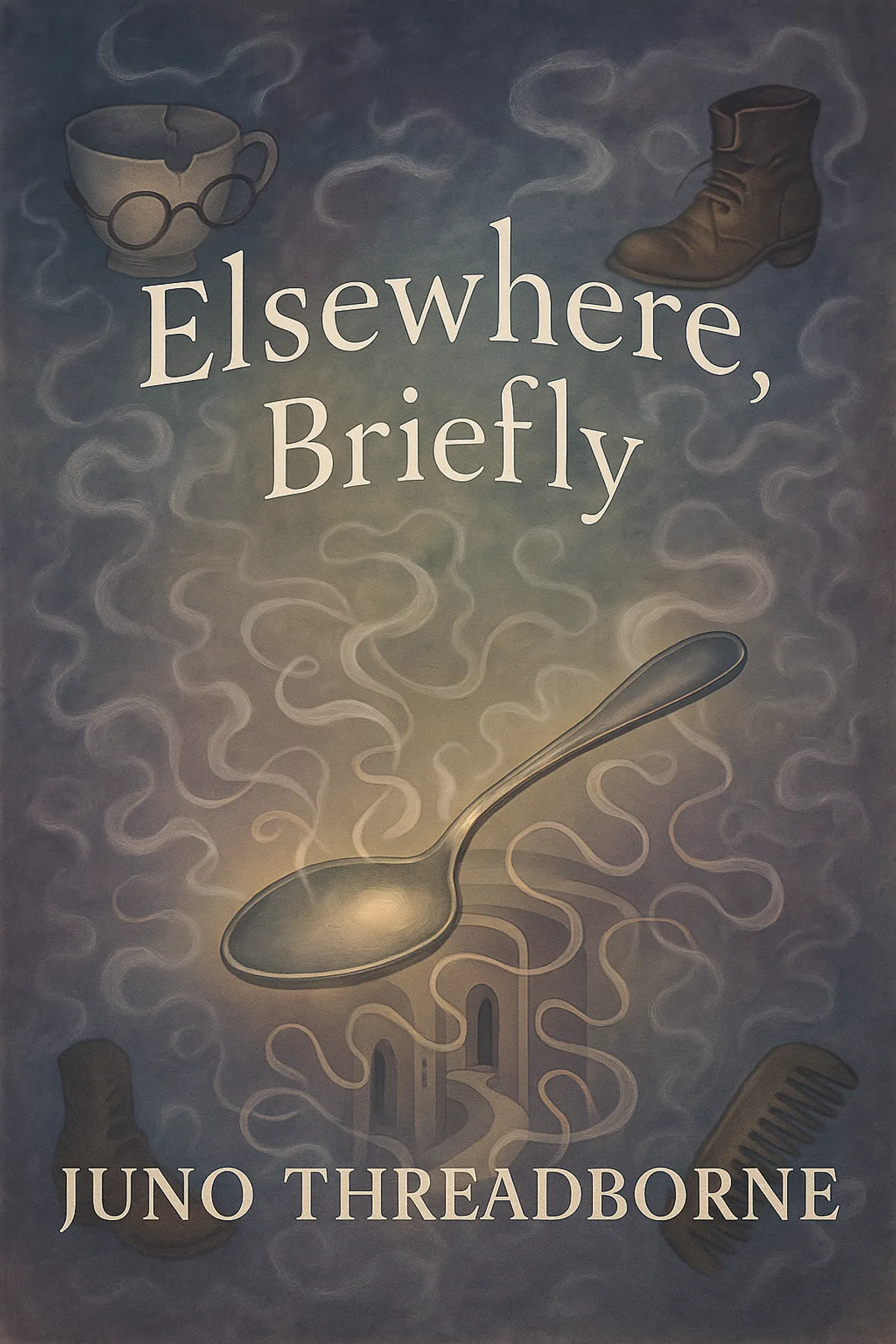
Elsewhere, Briefly
Book 6 of the Elsebeneath series
by Juno Threadborne
UNNECESSARY INTRODUCTION.
This place you seek,
the Elsebeneath—
is a place you may not know.
But you’ll soon divine that state and time
that caused a spoon to change its mind.
(And possibly its job. It’s management now.)
Chapter 1: The Errand
“Just Return the Ribbon, He Said.”
Sam wasn’t entirely sure what the errand was.
Something about a ribbon. Or a chime. Or maybe a chime with a ribbon attached to it.
Fen had explained it, sort of, but the explanation had included a diagram made out of spoon handles and the phrase “emotionally borrowed, not legally borrowed”—so Sam had chosen not to press.
The path was clear, at least.
A straight walk, a single right turn, and a polite knock on a door that might be a door but also might be a large wardrobe pretending to be a door for tax reasons.
Sam sighed.
Simple.
Which is, of course, when Fen said:
“Shortcut.”
It wasn’t really a suggestion.
He’d already veered left—off the path, around a hedge that looked like it had opinions about foot traffic, and into a field that was definitely wider than it had been ten seconds ago.
Sam stood there, one eyebrow gently ascending.
“Shortcut,” he repeated flatly.
Fen turned, walking backward with his arms out like a conductor leading an orchestra of invisible bees.
“The long way is overrated. Full of… expectation. Linear tension. Exposition. You don’t want that.”
“I kind of do.”
“Too late! We’re pivoting.”
And that was the last rational thing either of them said for quite a while.
The shimmer was subtle.
A quick flicker—like the world had blinked and come back with the saturation turned slightly wrong.
The grass went from green to ambitiously chartreuse. The sky hiccuped.
The wind made a sound like someone trying to whistle with soup in their mouth.
Then the field folded.
Not dramatically.
Just… a gentle crease. Like the Elsebeneath had gotten distracted and accidentally sat on this corner of itself.
The horizon tilted.
The colors held their breath.
Somewhere far off, a duck quacked in what might’ve been Morse code.
And just like that—
they were Elsewhere.
The path behind them had vanished.
The air smelled faintly of chalk, indecision, and extremely old bubblegum.
Sam looked around.
The trees were square now.
A few rotated slowly, like they were reviewing the scene for continuity errors.
Off to the right, a single boot floated six feet off the ground, emitting a low hum of passive judgment.
Sam turned to Fen.
Fen was already chewing something he hadn’t been holding two seconds ago.
“Where did that come from?”
“It was humming.”
Fen held up the snack—something between a pastry and a musical regret. “I figured it was edible.”
Sam stared at him.
Then he sighed, again. Deeply. Professionally.
“…So this isn’t the shortcut.”
Fen grinned.
“Nope. It’s the scenic route for people with bad luck and excellent instincts.”
The wind nudged them forward with the soft confidence of a story that didn’t know how it ended—but was absolutely sure it would be worth it.
They walked.
The boot followed.
Just in case.
Chapter 2: Entry Conditions
“If You Find the Door, Please Don’t Knock.”
The field gave up trying to be a field about ten steps in.
What had once been grass became… suggestion. Texture without texture. A soft carpet of maybe.
The path narrowed, except it hadn’t had a width before, and now it was just less than everything else around it.
Like it was being shy.
Ahead, the world curled inward.
Sam blinked.
Then blinked again.
The hallway—if you could call it that—was doing its best impression of a Möbius strip that had read about hallways in a dream.
It bent. Folded. Inverted once. Then re-inverted itself apologetically.
Doors hung at 45° angles. Steps looped into ceilings. A bench whispered to a broom about missed opportunities.
Sam squinted.
“Are we upside-down?”
“Emotionally, maybe,” said Fen.
They stepped inside.
The moment they crossed the threshold, the air snapped like a book being closed mid-sentence.
A small brass plaque shimmered into existence on a floating pedestal. It adjusted its height to match Sam’s eyeline, then winked out and reappeared at Fen’s shoulder instead.
It read:
WELCOME TO THE QUADRANT OF ERRANT ECHOES
Exit Conditions:
- Misremember something important.
- Misstate something obvious.
- Mispronounce yourself, with intent.
- Regret none of it.
To leave, follow your mistakes.
Please do not knock. The doors are sensitive.
Sam stared at it.
“So we’re trapped in a metaphor.”
Fen nodded solemnly.
“That’s the Elsebeneath, baby.”
The hallway folded again. This time toward them.
A door appeared to their left.
It had no handle, but it judged them with the full force of a forgotten birthday.
Sam stepped toward it.
Fen threw an arm out.
“Nope. Rule three. You’ve got to mispronounce yourself.”
Sam blinked. “What?”
Fen gestured grandly to the air, as if quoting a sacred text no one else could see.
“Mispronounce yourself—with intent.”
“How do you mispronounce—”
“Say your name wrong. But on purpose.”
Sam paused.
“Slam?”
The door groaned.
A hinge quivered.
A very faint sigh escaped from somewhere in the wall, like a tired librarian refusing to be impressed.
The door opened one inch.
Then stopped.
Then sneezed.
And closed again.
Fen nodded, approvingly. “Not bad. You just didn’t mean it.”
“How do I—how does someone mean Slam?!”
“Be Slam. Embrace Slam. Think with Slam energy.”
Sam opened his mouth.
Then closed it.
Then opened it again and very quietly muttered:
“…I am Slam.”
Nothing happened.
Fen cleared his throat, stepped forward, and said loudly:
“I AM FOON.”
The walls shivered.
The floor said, “What.”
The door exploded into glitter.
Beyond it lay another room.
Sort of.
It was like a hallway caught mid-molting.
Bits of sentence-fragment carpet sloughed off into corners. One wall was made of unfinished diary entries. The ceiling was a series of half-remembered jokes, muttering to themselves about better punchlines.
Sam stepped inside carefully.
The plaque floated after them. Its lettering adjusted to read:
“Progress acknowledged.
Next mistake, please.”
They walked.
The corridor pulsed once.
Somewhere far off, a wind laughed without explanation.
Footnote, probably:
The Quadrant of Errant Echoes does not endorse shouting your own name incorrectly as a means of psychological advancement. However, if it helps you find the hallway, we won’t stop you. We might giggle.
Chapter 3: The Buffet of Unfinished Thoughts
“Regret Comes with a Side of Breadcrumbs”
The corridor eventually gave up trying to be a corridor and just opened into a room that looked like it had once been a restaurant, then forgotten how.
There were tables, mostly. Some chairs.
One chandelier dangled from the ceiling by a ribbon labeled “DO NOT APOLOGIZE FOR THIS”, and another sat politely on the floor, humming to itself in C minor.
A sign near the entrance flickered into legibility.
WELCOME TO THE BUFFET OF UNFINISHED THOUGHTS
Today’s Special: Regret.No menus. No substitutions.
Please chew your intentions thoroughly.
DING if you forgot why you came.
A small bell rested on each table, glowing softly.
Sam passed one that bore the engraved phrase:
“For guests haunted by things that were almost clever.”
Fen, naturally, dinged it.
The waitress arrived almost immediately.
She was seven feet tall, wore a waitress uniform made of punctuation marks, and floated four inches off the ground. Her face was mostly jellyfish.
She handed them each a folded napkin and spoke in perfect sentence fragments:
“Choices irrelevant.”
“Order placed already.”
“Digestive discomfort optional.”
Then she vanished behind a curtain made entirely of overdue library cards.
Sam turned to Fen.
“You’ve been here before?”
“Once. Maybe. Could’ve been a dream about a courtroom. Same vibe.”
“Did you eat anything?”
“Not intentionally.”
Their food arrived instantly.
In front of Sam:
A plate holding what appeared to be the exact moment you forget what you walked into a room for—garnished with a sprinkle of false confidence.
He picked up the fork.
The food evaporated into a feeling of unresolved conversations and mild neck tension.
He sighed.
“This tastes like being interrupted halfway through a sentence and then never—”
“Exactly,” said Fen, chewing thoughtfully on something that looked like a waffle made of old birthday wishes.
“What’s yours?”
Fen glanced down at his plate.
It had changed shape three times in the last minute.
“I think it’s… the time I tried to be honest, but accidentally used sarcasm instead.”
He held up a bite. It sparkled, then wept.
“Tastes like pomegranate and disappointing eye contact.”
A busboy passed by, entirely composed of index cards. One fell off and fluttered to Sam’s feet.
It read:
“You said it didn’t matter, but you didn’t mean it. Would you like to try again?”
Sam folded it and slid it into his pocket.
Just in case.
The waitress returned.
“Dessert?”
“Today’s is whatever you meant to say last week.”
Fen raised a hand.
“I didn’t mean to say anything last week.”
“Exactly,” she replied, and handed him an empty plate.
Sam declined.
“I’m full,” he said, though it came out more like tired.
The jellyfish bowed, nodded, curtsied (twice), and faded into static.
As they left the restaurant, a new bell appeared above the door.
It rang itself once, politely.
Sam looked up.
“What was that one for?”
Fen shrugged.
“Could’ve been gratitude. Could’ve been indigestion.”
“Hard to tell the difference in here.”
They stepped back into the corridor.
The plaque was waiting.
“Mistake logged.
Continue.”
Footnote from the Host:
We regret to inform you that the buffet is not liable for any lingering metaphors. Please do not attempt to translate your entrée into closure. Some thoughts are served best unfinished.
Chapter 4: REDACTED
“Because the author—”
This section has been temporarily withheld due to narrative instability, emotional oversaturation, and a mild jellyfish-related incident.
The room was shaped like a— ████████████████████████████
Sam turned to Fen and said, “███████████████████████████████.”
Fen replied, “That’s the worst idea you’ve had since the teacup incident.”
Then he paused. “Wait. That was this. This is the teacup incident.
We’re in it.”The walls pulsed. One of them whispered something offensive about punctuation.
The mirror screamed and turned into a baguette.
No one addressed it.
[AUTHOR’S NOTE: This chapter was written during a moment of high emotional volatility, three misplaced metaphors, and one existential sandwich. Until the situation stabilizes, please proceed directly to Chapter 6: The Mirror of Correct Memory.]
[ALSO: Please return the spoon. You know the one.]
Chapter 5: The Mirror of Incorrect Memory
“That’s Not How It Happened”
The corridor stopped.
Not like a dead end. More like a decision.
Ahead: a room made of mirrors.
Not lined with mirrors—made of them.
Ceiling, floor, walls, corners, air. Reflective. Refractive.
Like the world was trying to remember itself and kept getting the angles wrong.
They stepped inside.
Immediately, their reflections disagreed with them.
One version of Sam stormed past, shoulders rigid, shouting at Vel—words Sam hadn’t said.
Not exactly.
Another showed him running away from Gable’s grief.
Not walking. Running. Cowardice written into the motion.
Sam flinched.
“That’s not—”
“Correct,” said Fen. “It’s not.”
“But I—”
“Didn’t. Or not like that. These aren’t mirrors. They’re drafts. Echoes with opinions.”
Sam turned to look at him.
Fen was watching himself in one of the panes:
crying.
Alone.
Bent at the knees on a frozen mountaintop, screaming into snow that didn’t echo back.
Fen stared at it. Then tilted his head.
“I don’t cry like that,” he muttered.
“I cry in trees. Get it right.”
Then the room shifted.
The reflections snapped into sync.
The mirrors stopped showing misremembered maybes—and instead started asking questions.
The mirror in front of Sam flashed once.
Then: a scene.
His old bedroom.
Vel on the floor.
His voice—angry. Clear.
This time, it was a real memory.
Only this version… rewrote itself.
Sam stood straighter.
Said the perfect thing.
Stopped the fight before it even began.
The air went still.
“What’s happening?”
Fen’s voice came from somewhere behind a thousand Sam-reflections.
“Rewrites,” he said. “The Elsebeneath’s most dangerous illusion.”
“It doesn’t show you lies. Just better versions.”
Sam watched himself apologize early.
He watched Vel smile.
The memory softened like a story that had learned to forgive itself.
It hurt.
“I want that one,” Sam whispered.
“Of course you do,” said Fen.
“So do I.”
Fen stepped into his own mirror.
The mountain again.
But this time, he didn’t scream.
This time, he turned. And Sam was there. And Vel was there.
And the cold broke first.
He touched the glass.
It shimmered.
Felt warm.
Felt easy.
“I could stay here,” Fen said.
“I could win the fight. Make the joke land.
Say the thing I never said.”
He looked at Sam.
“You know what that means, right?”
Sam nodded.
“We’d never leave.”
The room pulsed.
One by one, the mirrors fractured—not broken, but edited.
Cracks shaped like punctuation.
Sam stepped forward and did the only thing he could:
“That’s not how it happened,” he said.
The mirror didn’t resist.
It just sighed.
The version of him arguing with Vel flickered once, frowned, and vanished.
Fen tapped his version once with a knuckle.
“Nice try,” he said. “But I cry in trees.”
The mountain vanished.
They stood in silence.
A small mirror rolled up to them on tiny wheels.
It showed Sam at age five, in a superhero cape, crying because someone broke his action figure.
He looked at Fen.
“Do I have to correct this one too?”
“No,” Fen said. “That one’s just for context.”
The mirror saluted, then exploded into confetti.
They stepped through the final pane.
Light welcomed them like a hallway trying to act casual.
Fen stretched.
“Well that was… fun.”
He cracked his neck once.
“Next chapter?”
Footnote Fragment Recovered from the Mirror Archive:
Memory is not for accuracy. It’s for meaning.
Accuracy is what maps want.
Meaning is what people carry.
Chapter 6: The Game of Miscommunication
“Say What You Don’t Mean, But Mean It”
They walked for a while.
Not far. Just emotionally.
The corridor had reasserted itself, but with less commitment. It was now somewhere between a hallway and a waiting room designed by someone who had only ever heard of furniture.
Chairs faced each other at odd angles. A clock dangled upside-down from a ceiling that looked recently disappointed.
On one wall, a painting of a door was locked. On another, a door had been painted shut.
Sam rubbed his eyes.
“I feel like this room was built by a metaphor and its divorce lawyer.”
Fen kicked over a rug, revealing a tile with the word “ALMOST” etched into it.
Then the voice came.
“WELCOME, TRAVELERS.”
It did not boom.
It… sulked. Like an actor on their third take, unsure of the line’s deeper motivation.
“PLEASE TAKE YOUR PLACES.”
Two chairs spun slowly to face them. Between them sat a small table holding an hourglass and what appeared to be a microphone made of regret.
Fen flopped into his seat. Sam hesitated.
“THIS IS A GAME,” the voice clarified.
“A GAME OF ECHO AND ERROR.”
Sam sat.
The hourglass flipped itself.
RULES OF THE GAME:
You may only advance by saying something that your partner misinterprets.
The misinterpretation must still be emotionally true.
Do not apologize.
Points are… arbitrary.
The floor is mildly carnivorous. Do not drop metaphors.
A light dinged politely.
Fen leaned forward, elbows on knees. “I’ll start.”
He looked at Sam.
“You always do the dishes.”
Sam blinked. “Uh… thanks?”
The hourglass glowed. The door behind them locked with a satisfied click.
Sam frowned. “Wait, what just happened?”
“Your turn,” said Fen, grinning. “Say something I’ll misread.”
Sam hesitated. “I don’t think I understand the point of this.”
Fen gave a mock gasp. “So you think I’m pointless?”
DING.
A panel on the wall retracted.
A small flag emerged. It said: “2 POINTS TO SAM (ACCIDENTAL BUT VALID)”
They went on.
Fen: “You’re too good at words.”
Sam: “I don’t know what that means.”
Fen: “Exactly.”DING.
Sam: “I never mind your chaos.”
Fen: “You’re saying I am chaos?”DING.
Fen: “I didn’t mean to stay.”
Sam: “So you almost left?”
Fen: “Don’t ruin it. That one’s still fermenting.”SOFT BUZZ.
At one point, the microphone levitated slightly and whispered:
“Bonus round: say what you meant to say in the wrong tone.”
Sam stared at it. Then at Fen.
Then said:
“Thanks for showing up.”
Fen blinked.
Raised an eyebrow.
“Was that… sarcasm? Or earnest?”
Sam shrugged. “I honestly don’t know anymore.”
DING. DING. DING.
The table exploded into applause.
A door cracked open in the far wall.
As they stood, a final card fluttered down from the ceiling.
“Congratulations. You have successfully misunderstood each other in a way that felt almost kind.”
“This concludes Round One.”
Fen stretched. “Round one?”
Sam sighed. “Let’s not find out what round two is.”
Fen paused at the door. “That was actually kinda fun.”
Sam looked at him.
“You think maybe that’s the problem?”
Fen didn’t answer. But he smiled like someone who hadn’t said what he meant—on purpose.
And the door opened.
Footnote from the Game Master:
Language is not a contract.
It’s a scavenger hunt.
Sometimes the clue is wrong.
Sometimes the wrong answer is still the one you needed to hear.
Chapter 7: The Man with No Shoes
“I Mistook a Raccoon for a Poet Once”
The next room didn’t have a door.
Just… permission.
It waited for them like a question not fully asked.
They stepped in.
The air was quieter here. Still Elsebeneath—but like the Elsebeneath had been up all night talking too much and now needed tea and a long stare at the wall.
A thin stream wound its way through the space, not quite water, not quite sound. A few low stones made a path over it.
One hummed softly. One sneezed when Fen stepped on it.
And there—on the far side—sat a man.
He wore four scarves, no shoes, and the kind of layered clothing that said “I know what season it is, but I disagree.”
His face was lined but not tired.
His hands moved carefully—polishing a piece of old silver that didn’t reflect anything.
He didn’t look up.
“You’re late,” he said.
Fen blinked. “We weren’t invited.”
The man nodded. “That would’ve helped.”
Sam stepped forward, cautious. “Are you a guide?”
“Sometimes,” the man said.
He squinted at the silver. Turned it. Blew a speck off that might’ve been a thought fragment.
“Sometimes I’m just a bench.”
Fen tilted his head. “Do you know where we’re going?”
The man looked up, finally. His eyes were mismatched—one green, one curious.
“No one knows where they’re going here.
The Elsebeneath doesn’t go.
It remembers.”
They sat.
The man poured tea from a pot that hadn’t been there before.
It smelled like static and old lullabies.
“People think this place is about memory,” he said. “It’s not. Not exactly.”
He handed Sam a cup.
“It’s about what didn’t finish. What got paused. What got refused.”
He took a sip. “This quadrant’s full of them.”
Fen looked skeptical. “Like unfinished thoughts?”
“No. Unfinished refusals.”
The man leaned forward. “The things you couldn’t say, even to yourself.”
He gestured broadly. “Regrets, sure. But deeper than that.
Things like: ‘I won’t let myself heal.’
Or: ‘I’m not ready to stop missing them.’
Or even just: ‘I’m not done being angry.’”
Sam held his cup tighter.
“Why show us that now?” he asked.
The man smiled.
“Because you’re carrying something that isn’t yours.”
The silence tilted slightly.
Sam looked down.
Felt in his coat pocket.
The index card from the buffet was still there:
“You said it didn’t matter, but you didn’t mean it. Would you like to try again?”
It pulsed once.
Then went still.
Fen cleared his throat. “So what—somebody else’s echo hitchhiked into us?”
“Maybe,” said the man. “Or maybe something you left behind came looking for you.
Happens more often than you’d think.”
He stood, slow and creaky, like his knees were editing themselves.
“Do you know the story of the spoon?” he asked.
Sam blinked. “The one that changed its mind?”
The man nodded.
“Poor thing. Used to stir tea and hold medicine and dig small emotional holes in the garden.
But it got tired of other people’s mouths.”
He smiled, almost sadly.
“So one day it stopped being a spoon.”
Fen leaned in. “What’d it become?”
The man tapped his chest.
“Middle management.”
He turned, beginning to walk away—then stopped.
Without looking back, he said:
“The Elsebeneath doesn’t give answers.
It gives echoes.
And sometimes, it asks you to be the one who finishes the sentence.”
He paused.
“Good luck, Slam. And Foon.”
Then vanished.
Fen exhaled slowly. “Well. That felt like a riddle wrapped in a proverb dipped in sadness.”
Sam nodded.
Then looked at his tea.
It was gone.
In its place: a small spoon.
Bending very slightly.
As if… considering.
Footnote from the Barefoot Department:
Refusals are unfinished agreements.
Echoes are just waiting for someone brave enough to say the next line.
Chapter 8: The Stitcher’s Paradox
“Repair Requires Permission”
The corridor had unraveled behind them.
Literally.
A trail of yarn now marked where they’d walked, pulling itself loose from the floorboards like the hallway had second thoughts about being whole.
Sam stepped forward and nearly tripped on a loop.
“Did the architecture just apologize?”
Fen examined the strand. “No, no. It’s inviting us in. Like a breadcrumb trail, but emotionally manipulative.”
Sam followed, quietly hoping this didn’t end in a gingerbread metaphor.
They arrived in a room that smelled like thread tension and grandmothers who’d seen some things.
Spools of ribbon hovered in the air—some stitched with phrases, others blank. A floating needle traced slow figure-eights in the center, pausing occasionally like it forgot what it was about to say.
At the far end: a loom.
Large.
Breathing.
It sat atop a pedestal made of mismatched apologies and held a sign:
STITCH SOMETHING TRUE.
Do not mend what isn’t yours.
Do not improve what wasn’t broken.
Do not pull the thread unless you’re willing to follow it.
Sam swallowed.
Fen grinned. “We’re gonna ruin something, aren’t we?”
They approached.
A ribbon unfurled midair, trembling slightly.
Words began appearing—slow, like a shy admission:
“I shouldn’t have—”
“It wasn’t fair—”
“But you left first.”
The thread above it sparkled with potential.
Sam hesitated.
“Should we finish it?”
“Nope,” said Fen. “That’s someone else’s sentence.”
He pointed at a different ribbon. This one blank—except for a single word at the end:
“Again.”
Fen rolled up his sleeves. “This one’s ours.”
The loom shivered as Fen stepped forward.
He guided the floating needle. Carefully.
Then recklessly.
Then accidentally on purpose.
Sam tried to help—but the thread resisted. It snagged. Twisted. Formed shapes that looked like apologies but read like sarcasm.
The room dimmed.
The loom stuttered.
And the ribbon snapped in half.
Everything froze.
The thread hovered mid-air, taut with tension.
Then, from the silence:
“You didn’t ask.”
It came from the wall.
Which had now become a face.
A large, patient, disappointed face.
“You tried to fix something that wasn’t broken,” it said gently. “You assumed mending is always welcome.”
Sam stammered. “We were just trying to help—”
The wall nodded. “Intent is not consent.”
The needle landed softly on the ground, curling into a question mark.
The room began to dissolve—softly. Kindly.
Not in anger.
Just in release.
Ribbons folded back into the air. The loom deflated with a tired sigh.
Only one object remained:
A spoon.
Bent slightly.
But whole.
Fen stared at it.
“I think we just fixed the wrong thing into being the right thing.”
Sam picked up the spoon.
It pulsed once.
And hummed.
Footnote in Fine Thread:
To repair something is to presume its desire to stay stitched.
Some metaphors aren’t ready.
Some don’t want fixing.
Some want to be seen, bent, and heard.
Chapter 9: The Conference of Inanimate Objects
“Every Tool Remembers Its First Job”
The corridor ended in a polite cul-de-sac.
Not dramatic. Not ominous. Just… the architectural equivalent of shrugging.
In the center sat a large, circular table.
Around it: a committee.
Not of people.
Of objects.
A cracked teacup with reading glasses perched on its rim.
A comb missing three teeth and full of righteous indignation.
A lamp that flickered whenever anyone said “responsibility.”
And at the head of the table—
A spoon.
Bent.
Polished.
Radiating the quiet authority of someone who’d seen too many metaphors misused and wasn’t afraid to file a complaint.
Sam and Fen arrived cautiously.
“Should we sit?” Sam whispered.
Fen nodded toward the placards now appearing in front of two empty chairs.
Slam.
Foon.
They sat.
The spoon cleared its throat, which should not have been possible.
“This is a hearing,” it said, “on the misuse of meaning.”
Sam blinked.
“Sorry—are we on trial?”
“No,” said the spoon. “You’re witnesses.
Also suspects.
Also cleanup crew, if this goes poorly.”
Fen leaned in, whispering:
“I think this is the Elsebeneath’s version of a staff meeting.”
The comb rattled.
The teacup tutted.
And the spoon continued.
“You’ve interfered with four metaphor engines, disrespected one buffet of unresolved cognition,
rewrote an emotional mirror without citation, and
encouraged at least one unauthorized spoon-to-management promotion.”
Fen raised a hand. “In our defense, most of that was your fault.”
The spoon tapped once against the table. A chime rang in the air, shaped like a sigh.
“It’s not about fault,” the spoon said. “It’s about what gets carried forward.”
The table began to spin.
Not fast.
Not threatening.
Just enough to blur the line between objects and stories.
Sam felt the weight in his coat pocket shift.
The card. The unfinished ribbon. The cracked laugh he’d been keeping since Chapter 3.
They spilled out. Floated gently onto the table.
Each one shimmered.
Each one spoke.
But not in words.
In pull.
Memories that wanted to finish themselves.
The spoon turned to Sam.
“You kept the card.”
“I didn’t know what it meant yet.”
“Good.”
It turned to Fen.
“You let the mirror show you the better version.”
Fen shrugged.
“Didn’t keep it, though. Didn’t live in it.”
“Better.”
Then the spoon looked at itself in the polished metal of the table.
Its reflection didn’t match.
For a moment, it looked like… a spade.
A ladle.
A tuning fork.
A quill.
And then—
Just a spoon again.
“I changed,” the spoon said quietly.
“And I thought that meant I had to stay changed.”
Sam stepped forward.
“No. You just get to choose now.”
The table went still.
Around them, the objects exhaled.
The teacup bowed. The lamp flickered one last time, then dimmed.
The comb—grudgingly—smoothed itself.
And the spoon?
It lifted.
Spun once.
And stuck itself gently into the center of the table—
Like a key.
The room shifted.
Reality folded politely at the corners.
And a door appeared.
Above it, etched in silver:
EXIT GRANTED.
BECAUSE YOU MEANT IT.
Fen whistled. “So. That was weird.”
Sam nodded. “We saved a spoon from existential management.”
Fen: “And ourselves from mirror-based delusion.”
Sam: “And memory from being a prison.”
They stepped toward the door.
The boot from Chapter 1 hovered beside them, humming a little celebratory waltz.
Final Footnote (Filed and Approved):
You are not what you were made to be.
You’re what you decide to keep being—even after someone bends you.
Chapter 9.5: Things Remembered Differently
The door closed behind them.
Not with ceremony. Not with finality.
Just… a soft click. Like a sentence finishing itself politely.
They didn’t step into a corridor.
They stepped into else.
The air felt familiar in a way Sam couldn’t place—like a dream he’d outgrown, or a tune that had changed key since the last time he hummed it.
Fen blinked.
“Uh…”
He turned in a slow circle.
There was no buffet. No mirrors. No whispering walls or floating footnotes.
Just a hill.
Just wind.
Just… a cottage.
Simple. Quiet. Real enough to make everything else feel slightly stage-lit.
They stood at the edge of a meadow that hadn’t been there a moment ago.
The Elsebeneath, it seemed, had once again… pivoted.
Sam looked back.
The door was gone.
Fen sniffed. “That felt like a transition cut. Did we just get scene-changed?”
Sam didn’t answer.
He was already walking toward the cottage.
It wasn’t far.
Just far enough that the wind had time to hum a tune neither of them knew, and a cloud passed overhead in a shape that looked almost intentional.
The cottage was weathered, but not neglected.
Its walls leaned inward like they were confiding in each other.
Smoke curled lazily from the chimney, despite the absence of a fire smell.
The door was open.
Because of course it was.
They stepped inside.
The interior was warm. Not cozy—lived in.
Books, half-read and spine-worn.
A kettle on, but not whistling.
A map on the wall with no labels—just small, silver thumbtacks pressed into oceans and margins.
And at the table: a man.
He looked… not old, but time-worn.
Like someone who’d asked too many questions and gotten just enough answers to regret it.
He smiled when he saw them.
“Visitors,” he said.
Not surprised. Not bored.
Just… pleased.
“Didn’t think I’d see any more of those today.”
Fen raised a hand. “Hi. Sorry. We, uh… Elsebeneathed ourselves again.
Not sure if this is still part of the trial or the cooldown sequence.”
The man chuckled. “You’re through all that.
This part’s just for you.”
Sam stared at him. Narrowed his eyes.
“Do you… live here?”
The man nodded. “More or less.”
“Are you from the village?”
“No,” he said. “I’m from… before the village.”
He stood and poured tea without asking.
Set three cups on the table.
Then, as he sat again, he said—
“I’m Graham.”
Sam froze.
His hands twitched—scarf. Where’s the scarf.
He reached for it. Felt nothing. Blinked hard.
Fen noticed. “You okay?”
Sam opened his mouth. Then closed it.
“I gave it to Gable,” he said softly.
Graham looked up. His expression didn’t change—but something behind his eyes shifted.
Not menace. Not delight.
Just… memory.
“That was kind of you,” he said.
Sam stared.
“You’re real.”
Graham tilted his head. “So are you.”
A pause. Long enough for the tea to cool slightly.
Fen looked between them. “So, uh.
What’s the catch here? Are you going to disappear in a puff of closure?
Or challenge us to a riddle duel? Or whisper something haunting that doesn’t resolve until book seven?”
Graham smiled.
“I’m just going to pour the tea.”
And he did.
They drank in silence for a while.
Sam kept glancing at the scarf that wasn’t there.
Fen tapped a rhythm on the table with one finger, like he was testing the emotional acoustics.
Eventually, Sam spoke again.
“You’re not what I expected.”
Graham nodded.
“I hope that’s a good thing.”
Some memories arrive late.
Others were here first.
But all of them—eventually—
ask to be met again.