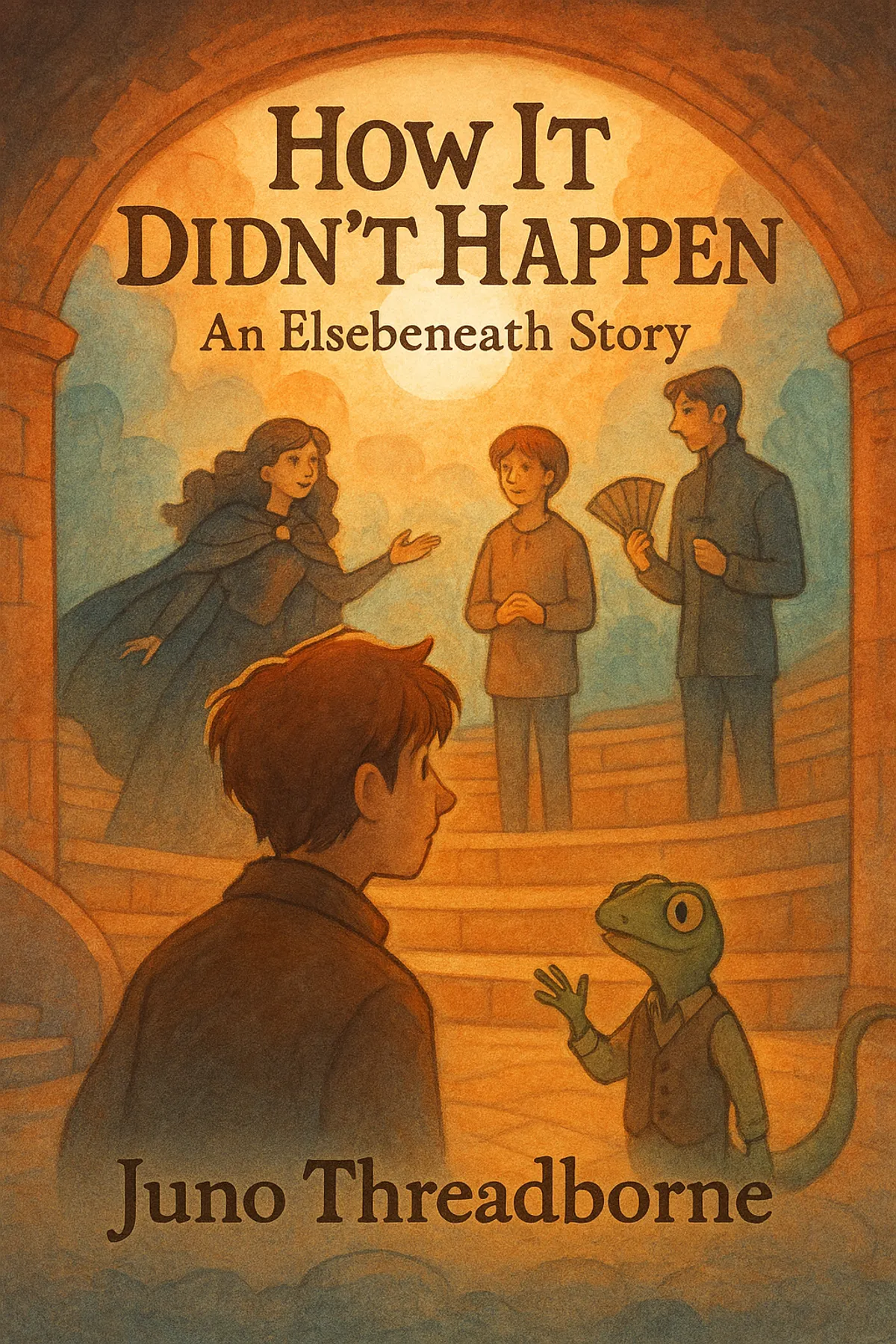
How It Didn’t Happen
An Elsebeneath Story
by Juno Threadborne
Chapter 1: The Amphibio’théatre
Sam hadn’t meant to stay long.
He’d only come to the Village of Voicekeepers for a ribbon. A simple one. Sky-colored, if he could find it. The kind that didn’t whisper too much when the wind passed by.
The scarf-seller’s stall had dozens, of course.
Too many.
One of them laughed as he reached toward it. The seller didn’t seem to notice. She was too busy rearranging her display, murmuring to the ribbons like a florist calming a restless bouquet.
Sam ran his fingers through the tangles of fabric. Some of them had messages written in pen, others plain, others with designs that changed with their mood.
He chose a simple cornflower blue ribbon. It had the words, “because your voice matters to me” in shiny gold lettering on one side.
He held it in his hand for just a moment—just in case something Elsebeneath happened.
But it stayed quiet. Ribbons only whispered if you were unsure what they were meant to carry.
He pulled the ribbon from the tangle.
“Perfect,” he thought out loud. He left a handful of buttons on the counter and bounded out the door.
Up the street, a weathervane was arguing with a chimney about whose turn it was to point at the clouds.
It was one of those mornings.
He wandered past the fountain.
Past the chime that always rang when someone was almost about to say something important.
Past the bakery with the jam that tasted like secrets you hadn’t told yet.
And into the square where the wind liked to rehearse.
He paused.
Not for long. Just enough to notice that the breeze was tugging left today—toward the overlook.
Sam almost said something.
He didn’t know what.
He thought about the ribbon in his pocket.
He hadn’t picked it for anyone in particular. But maybe he had.
Maybe himself.
He wasn’t great with saying things. Not when they mattered.
He liked to get it right. To understand first. To wait for the shape of a moment before filling it.
Which meant sometimes…
He missed his chance entirely.
As he reached the edge of the village, he caught something in the corner of his eye.
An amphitheater.
Stone walls curved like cupped hands.
A staircase flowed downward, inviting and dramatic.
And just as Sam blinked—
The whole façade blushed.
A warm coral hue bloomed across the stone, rippling like a skipped heartbeat. Somewhere above, a spotlight flickered into existence and aimed itself not at the stage—but at Sam.
He blinked again.
Then a voice called up from below.
“Oh! Um. Hi! Don’t mind her. She just gets like that sometimes.”
Sam squinted.
A young gecko in a vest three buttons too confident for its wearer waved both hands—then thought better of it and tried to look casual, which made everything worse.
“Sorry,” he said, tail twitching. “She’s been dormant all week. You show up with an armful of honest emotion and she lights up like a sunrise. Typical.”
He trotted up a few steps, offered a nervous smile, and stuck out a webbed hand.
“I’m Glin. I run the place.”
Sam shook it.
“The wall just… blushed at me.”
Glin winced. “Yeah. She does that. You didn’t say anything dramatic, did you?”
“Not yet.”
“Good,” Glin said. “Just—try not to monologue. Not until you’ve had a proper introduction. The stage is a bit of a sucker for big entrances.”
He gestured down the staircase.
“Come on. I’ll show you around.”
Chapter 2: Staged
Glin talked like someone trying not to notice a fire in the other room.
“This is the cue well,” he said, gesturing to what looked like a wishing fountain full of torn script pages. “Technically she calls it the Well of Implied Meaning, but—well. It mostly just coughs up scene changes when people get vague.”
A wet splat sounded behind them. Another page surfaced, smoking slightly at the corners. Glin ignored it.
Sam followed him down a narrow corridor lined with mismatched curtains. One of them blinked.
“She responds best to clarity,” Glin went on. “Strong choices. Honest feelings. Theatricality is fine—encouraged, really—but if you try to fake your way through a scene, she’ll chew it and spit it out.”
“Chew it?”
Glin nodded. “One time she turned a monologue into actual bees. Thousands.”
Sam’s mouth opened to speak, but behind them, someone shouted something muffled and sharp. Another voice hissed in reply. Sam glanced over his shoulder. Glin quickened his pace.
They passed a stack of props labeled NOT CURRENTLY RELEVANT and a full costume rack that shuffled slightly when Sam leaned in too closely.
“This is wardrobe,” Glin said, stopping for breath. “Don’t touch anything unless you want your outfit to match your subconscious.”
He pulled a curtain aside and waved Sam through.
“And here,” he said, as they stepped into the main space, “is the Stage.”
It was bigger than Sam expected.
Circular, tiered, and half-draped in clouds. The seats looked like they’d been carved from old applause—shaped by clapping hands and smoothed by time.
The Stage itself was empty.
And not.
The top tier of the stage was ringed by a thick crimson curtain. Somewhere above, lighting rigs moved without wires. A breeze passed that tasted like the end of an argument. And faintly, just under the surface of everything, the floor throbbed—like a drum that hadn’t picked a rhythm yet.
From somewhere behind the curtain, Sam heard a voice. Low. Gravely.
“Last week, I could’ve sworn it ended with a door closing. But yesterday I watched it close before anyone left.”
“Who’s that?” Sam asked.
“Don’t worry about them,” Glin said, a bit too brightly. “Why don’t I finish showing you around?”
He turned before Sam could respond and started toward the far end of the stage, gesturing to a staircase carved into the stonework. It wasn’t clear if it led up or down—only that it moved somewhere else.
“Is it always like this?” Sam asked, keeping pace.
Glin didn’t look back.
“Like what?”
“The Stage. The lights. The…” He gestured vaguely. “Mood.”
“Oh,” Glin said. “Right. No, she’s just in one of her loops again.”
“Loops?”
Glin nodded. “She gets like this when a scene won’t settle. Doesn’t know which version to hold onto, so she keeps trying them on—like costume changes.”
Sam heard another voice. This one lighter.
“It was a goodbye, or a warning. I honestly don’t know anymore.”
Glin kept walking. They passed a spiral staircase that dissolved as they reached the bottom step, and a doorway labeled NO ENTRY DURING REWRITE.
He pointed as they passed:
“That’s the Emotion Pit. Don’t fall in—it’s mostly unresolved tension and fog right now. Over here’s the Inflection Balcony. Great acoustics, terrible for subtext.”
Sam raised an eyebrow.
“And that,” Glin said, pointing to a stone arch shaped like an ellipsis, “is the Hall of Unspeakable Lines. Don’t ask.”
Another shout rang out behind them. Closer now. Followed by a voice that dropped like a guillotine.
“Do not bring me into this.”
Sam stopped.
“What are they arguing about?”
Glin stopped too.
His shoulders slumped. Just for a second.
“Something about the final scene,” he said at last. “It changed. Or they did. Or both.”
Sam tilted his head.
“Changed how?”
Glin hesitated. Then sighed.
“The door. I think it should’ve been a gate.”
Sam frowned. “But you run the place.”
“Sure,” Glin said. “But the Amphibio’théatre doesn’t answer to me.”
They turned back toward the stage.
A loud thud, and the curtain rose. In its place stood three actors.
The first—a woman in a cape—paced in tight circles, her boots striking harder than necessary.
The tall one leaned against a curtain rod that hadn’t been there before, arms crossed, one eyebrow raised like a challenge he hadn’t bothered to voice.
And the youngest—
He hovered.
You could feel it. Their steps were hesitant, each one angled slightly toward someone else. They looked like they were trying to agree with all three of them at once.
“Should we leave?” Sam asked.
Glin grimaced.
“We’re in it now.”
They stepped forward as the woman turned sharply.
“I am not going through it again,” she said. Her cape flared like a wall of candles. “We made the choice. We rehearsed the choice. And then he—” She pointed at the tall one without looking at him. “—decided it was the wrong kind of tragedy.”
The tall one unfolded his fan with a snap. “No,” he said calmly, “I decided it was lazy. You can’t substitute silence for resolution and call it art.”
“That’s not what it was,” said the youngest, but no one looked at him.
“Glin,” the woman said, still staring at the fan. “Tell me you’re not dragging in civilians.”
“I’m not dragging,” Glin muttered. “I’m… inviting.”
She scoffed and folded her arms.
“Wonderful. An invited audience.”
Sam shifted his weight.
He was used to stories. Used to feeling them move.
But this wasn’t movement. It was static.
And it hummed.
“You think I meant to forget?” the youngest blurted. They had turned to the woman now—small, unsure, unraveling.
She didn’t answer.
Sam looked to Glin. Glin raised his hands helplessly.
“You said the scene changed,” Sam said. “What was it before?”
Three heads turned toward him.
Three different silences followed.
Chapter 3: Her Lines
It was the cape that moved first.
“Fine,” she said.
Then louder:
“Fine. I’ll just show you.”
She reached up, unfastened the clasp at her shoulder, and flung her cape high into the air.
It caught the stage light mid-spin, swallowed it whole, and drifted down slow—like a curtain falling before the scene even started.
Darkness pooled in its wake.
Then: a single spotlight.
Cal stepped into it like she’d been born for it.
And then she began.
“The room was quiet.” Her voice echoed, just slightly.
“Not because there was nothing to say. But because sometimes… silence says exactly what it needs to.”
The stage obeyed. It painted the walls in melancholy dusk.
The furniture rearranged itself around her like a loyal ensemble.
A chair, a map, a door.
She stood center.
“He was already halfway gone,” she said, not looking toward Jun. “And I knew better than to chase someone who had decided to leave.”
She walked slowly, one hand brushing the edge of a table that hadn’t been there a moment ago.
“I could’ve said something. Of course I could’ve. But what? ‘Stay?’ When that wasn’t what he wanted?”
Behind her, Jun’s silhouette stood frozen in the doorway—just close enough to hear, too far to touch.
“No,” she said, softly now. “I did what was kind.
I let him go. With dignity.”
Sam couldn’t look away.
It wasn’t just the performance—though Cal commanded the light like it owed her something.
It was the way the air responded. The way her words curled up the rafters like smoke pretending not to be fire.
The Stage listened.
It didn’t believe her. But it listened.
And Sam was learning to tell the difference.
He scanned the scene.
Everything was too clean.
No tension. No missed glances. The door behind Jun hung open like a polite afterthought.
Even Arin—seated to the side, hands folded—looked more like a prop than a person. No fidgeting. No storm behind the eyes. Just quiet admiration. Like a student watching a master class.
Jun stood up.
“That’s not how it happened.”
Cal froze.
The lights rose.
And Jun stepped up.
Chapter 4: His Lines
Jun didn’t move for a long time.
The stage still wore Cal’s silence like a shawl.
But then — slowly — he stepped forward.
No flourish. No cue.
He didn’t call for lights.
They came anyway.
A single warm wash.
Soft edges. No spotlight. Like the theater was listening, but not performing.
“It wasn’t a door,” Jun said.
His voice was low. Not quiet, exactly — just the kind of voice you leaned toward without knowing why.
“That’s what she remembers. Because that’s what she gave me. A door. An exit. A clean goodbye.”
He gestured towards the back of the stage.
“But I saw a hallway.”
He walked slowly across the stage, and with each step, the set changed.
Walls stretched. Lamps flickered on, one by one.
It became a corridor now — narrow, uneven, a little too long.
“I didn’t want to go.”
Behind him, Cal stood still. She didn’t interrupt.
“But I didn’t know how to stay.
No one said I could.
And I wasn’t brave enough to ask.”
The hallway closed behind him.
Now the lighting shifted again — colder this time, distant.
“I told myself leaving was the right thing.
That it made space for what they needed.”
A chair appeared. He sat down.
He didn’t perform. He remembered.
“I stood in the doorway.
I waited.”
The Stage flickered.
A silhouette emerged — Arin, barely formed.
They looked at the figure. But said nothing.
Jun stared at the echo.
“I thought… if someone said my name, I’d stop.
If someone reached for me, I’d turn around.”
The echo didn’t move.
“No one did.”
Jun stood again.
The hallway crumbled behind him.
He looked at Cal. Not with blame.
And then at Arin.
“I’m not asking to be forgiven,” he said.
“I just wanted you to know…
I didn’t leave because I didn’t care.
I left because I didn’t believe I was allowed to stay.”
Cal looked away.
Jun just stood there, hands in his pockets, like he was waiting for a train that might never come.
Sam took a slow step back from the stage.
Glin was at the steps, arms crossed, chewing the inside of his cheek like it owed him rent.
Sam joined him quietly.
“So…” Sam said, “he left.”
Glin nodded.
“Yeah.”
“And she let him.”
“Yeah.”
Sam squinted toward Arin.
“So what about them?”
Glin followed his gaze.
Then: a sigh. Not dramatic. Just tired.
“Arin wasn’t supposed to be in the scene.”
Sam blinked. “What?”
Glin tilted his head.
“That part was smaller, originally. Three lines. A stage direction.
They weren’t even cast until the second rewrite.”
Sam looked again.
Arin was still watching the page.
“Then why are they still here?” he asked.
Glin didn’t answer right away.
Then:
“Because they remember all the versions.”
Chapter 5: Their Lines
Arin stepped forward.
Slowly.
No light followed.
They didn’t ask for one.
But after a moment—when they reached the center of the stage—
a soft white glow found them anyway.
Like the Stage had been waiting for them to finally speak.
Only they didn’t.
Not yet.
They took their place in the same scene.
The one Cal had conjured. The one Jun had reshaped.
The table appeared again.
The chair.
The long corridor—unfinished, halfway between memory and myth.
Arin moved through it like someone walking through an old photo.
One hand brushed the map Cal once held. One foot hesitated at the spot Jun had stood.
Then they spoke.
Not loud. Not bold. Just true.
“No one said anything.”
They looked toward where Cal had once stood.
“You wanted him to go.”
Then at Jun.
“You waited for her to stop you.”
They stepped backward now, to where they had been in both stories.
Folded hands. Still breath. Eyes trained on the floor.
“I was there,” they said. “I was always there.”
And then something strange happened.
They turned—
—and spoke Cal’s line.
“I did what was kind.”
But this time… it didn’t sound like dignity.
It sounded like doubt.
They took another step.
“I didn’t believe I was allowed to stay.”
But this time, it cracked. Not broken. Just open.
The Stage reacted.
It shimmered—not a transformation, but a blending.
The corridor became a room.
The door became a threshold.
The silence between them—finally visible.
Like a space-shaped ache.
Arin stepped into it.
Looked at both of them.
“I wasn’t written into the scene.”
“But I was part of it.”
The stage held them all in soft, suspended light—like it hadn’t decided whether to end the scene or rewind it.
Then Cal exhaled.
Sharp. Too loud.
“That’s not what happened.”
Arin flinched.
Not visibly. Just enough for Sam to notice.
Cal stepped forward.
“You were there, yes, but—don’t make this about you.”
Her voice was tight now. Controlled.
“We all hurt. But some of us actually had to make a choice.”
Jun didn’t speak. But his body did.
He shifted slightly—away from Cal.
Arin’s hands curled into fists at their sides.
“I’m not trying to—”
“You’re rewriting it,” Cal snapped. “Like I was just… cruel.”
“You were,” Arin said, voice trembling. “Not always. Not completely. But in that moment—you let both of us stand there and say nothing.”
A pause.
“That’s not kindness.”
The Stage flickered. Like too many truths were trying to surface at once.
Jun stepped forward now—only one step—but it was enough to pull the energy sideways.
“Stop.”
His voice was quieter than Cal’s. But it cut through the space anyway.
“Just stop.”
He looked at both of them.
“We’re all right. And we’re all wrong. That’s the problem.”
The cue well gurgled softly. No page emerged.
Not yet.
Sam stood at the edge of the stage, ribbon still in his hand.
Waiting.
Watching.
Listening.
The stage dimmed—just slightly—as if it, too, was bracing for the final line.
Chapter 6: Curtain Call
The cue well sighed.
Not a gurgle. Not a splat.
Just… a sigh. Like something old had finished holding its breath.
Then a page surfaced.
Whole. Unburned. Edges intact, as if it had never torn in the first place.
Sam stepped forward and plucked it from the surface. It was warm. Faintly pulsing, like a heart that had just remembered its own rhythm.
Glin peeked over his shoulder.
“That’s the final draft,” he said. Then added, “Or the first one. Hard to tell with her.”
Sam didn’t answer.
Not right away.
He looked across the stage.
At Arin. Still standing. Still open.
Then down at the ribbon in his hand.
He crossed the floor, slow but certain, and held it out.
Cornflower blue.
The words shimmered gold in the light.
“Because your voice matters to me.”
Arin didn’t speak.
But they took it.
Held it carefully, like something breakable and sacred.
Then nodded.
Just once.
The Stage stirred.
No lights flared.
No music swelled.
But the set began to move — not rebuilding any one version of the scene, but blending pieces from all of them.
A corridor.
A map on a table.
A chair angled slightly toward a door that didn’t close all the way.
The air thickened — not with tension, but readiness.
Like the story itself had been waiting.
Jun stepped forward first.
Cal followed.
Arin took their place between them.
No one spoke.
Not yet.
The lights settled.
And the story began.
Cal’s voice was the first.
But it wasn’t the same line.
“The room wasn’t quiet.”
A pause.
“We were.”
Jun stepped forward.
“I waited.”
He looked at Cal. This time, she looked back.
Arin reached for the map on the table. Unfolded it. Laid it flat.
“No one said the words. But the choice was made.”
They weren’t taking turns.
They weren’t performing.
They were remembering.
Together.
Jun stepped toward the door.
Cal turned — not away this time, but toward him.
“I didn’t say ‘stay,’” she said.
“Because I didn’t know if I meant it.
But I wanted to.”
Jun’s voice cracked.
“I thought leaving would keep things simple.
It didn’t.”
Arin sat in the chair. Held the ribbon loosely.
“I was part of it.”
They looked at the others.
“Even if none of us knew how to write me in.”
No music.
No stage cue.
Just quiet.
Shared.
Held.
The lights dimmed.
And for a moment, the stage pulsed with a color none of them could name.
Applause didn’t follow.
But something like it did.
A breeze circled the rafters.
The lights warmed, just slightly.
The floor stopped humming.
The cue well stilled.
And somewhere behind the set, a script unrolled itself and fell silent.
Sam stood at the back of the house, Glin beside him.
They didn’t speak for a while.
Then Glin said, “You know, some stories… they don’t care if they’re remembered.”
Sam glanced over. “So why tell them?”
Glin shrugged. “Because we care.”
On stage, the trio had started talking. Quietly. No performance. No need to be heard.
Just three people, finally listening.
Sam turned to leave.
The theater blushed again. A soft, coral bloom. No spotlight this time. Just light. Welcoming.
Sam didn’t say anything.
But the wind caught something as he passed the archway.
Just a whisper.
Just enough.