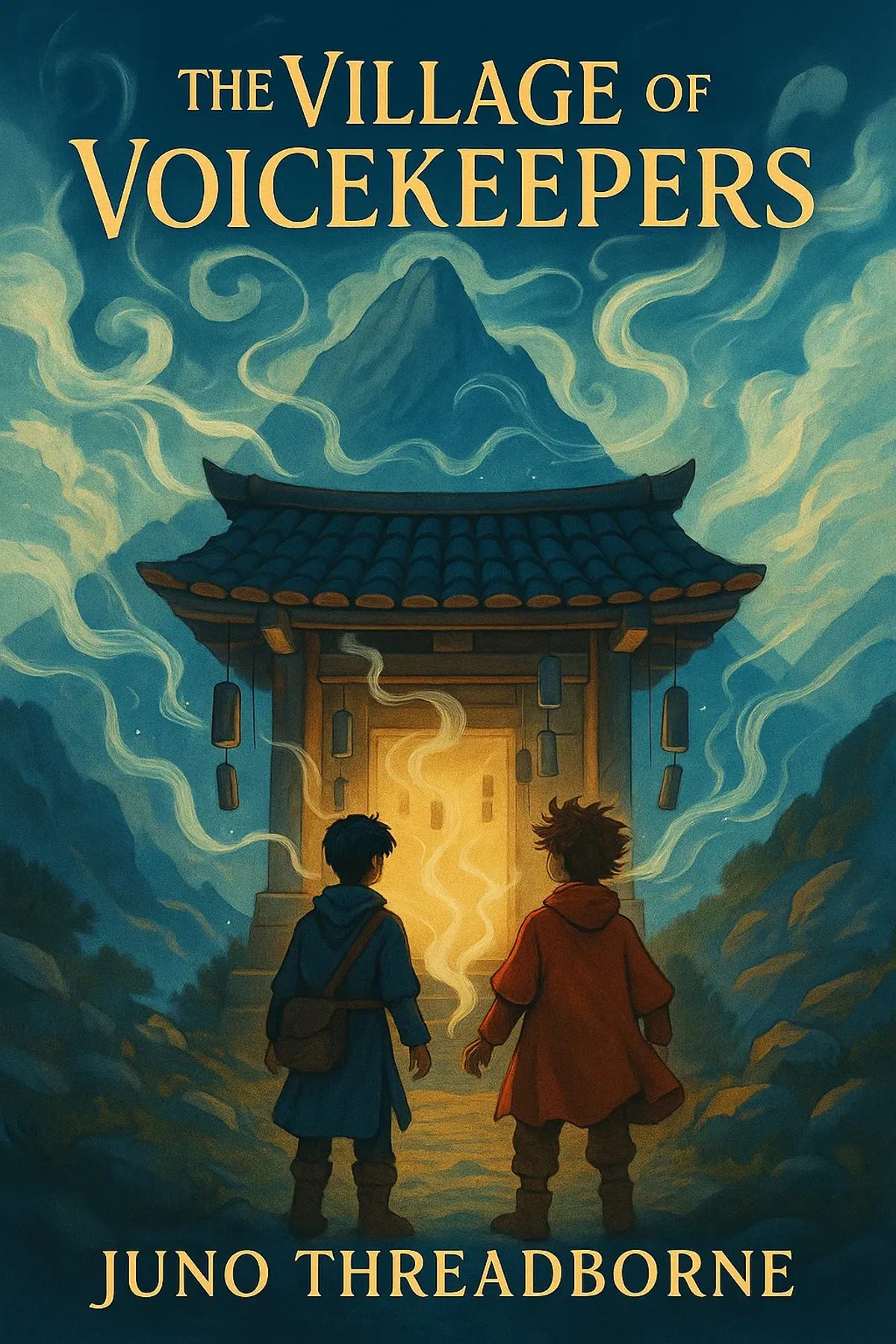
The Village of Voicekeepers
Book 4 of The Elsebeneath series
by Juno Threadborne
Chapter 1: The Wind in the Walls
Sam didn’t mean to fall asleep.
He lay face down on the bed, socks half-on, his cheek pressed to the spiral of a notebook he hadn’t touched all week. The fan in the corner clicked with every third rotation. He’d counted.
The new house didn’t creak like the old one. It just sat still. There weren’t floorboard groans or cupboard sighs. Just… stillness. Like the walls hadn’t learned how to breathe yet. He’d checked.
Down the hallway, someone was watching TV too loudly. The kind of show that seems afraid of silence. Sam didn’t mind. He’d gotten good at listening past the noise.
Outside, the wind tapped lightly at the window. Just one note, waiting for him to answer.
He didn’t.
He thought the new house would be fun.
Maybe he’d lied.
His eyes fluttered closed, though he hadn’t quite meant them to. He turned once. So did the room.
He opened his eyes, and he was… standing.
Not in bed. Not at school. Not anywhere that felt like it needed explanation.
There were trees here, but they didn’t behave. They leaned the wrong direction. Their leaves curled inward, trying to remember something they never knew.
The sky above wasn’t exactly a color. It was the feeling you get just before someone finally says what they meant. Fuchsia clouds curled lazily across the sky, softening into veridian at the horizon.
And the wind…
It didn’t rush. It wandered. Tugging gently at his sleeves like it was glad to see him again. Some of it shimmered politely, as if it had something to say.
It was strange.
And… comforting.
Far ahead, a bell rang. Not quite music. More like the first word of an apology.
Sam stepped toward it.
There was a village at the edge of the field—like the wind had dropped pieces of memories as it passed by, and the houses they made just learned to stay.
Just past the first door, a windchime dangled from an awning—made of a plastic toy, a spoon, and the broken arm of a pair of glasses.
As Sam passed, the breeze curled through it gently.
It didn’t sound like metal or wood. It was more of a voice—soft, careful. The kind of voice that says your name when they’re afraid to wake you.
Sam paused.
“Hello?”
Nothing.
The breeze swirled once, sheepish, and moved on.
He shook his head.
Must’ve imagined it.
On the edge of the first street, a hung from a wire, tilted just so—listening
There was laughter somewhere, but it was the quiet kind. Friends gossiping, but with a warm tintinnabulation. Like silverware telling secrets in the wind.
The wind tugged him along again.
The sun had already sunk below the horizon, but the sky hadn’t figured that out yet. Its edges were endless shades of violet; clouds swirling in lazy curls across a canvas of orange and pink.
In the village square, wind chimes were chatting—more like neighbors than decoration. They traded in forgotten sounds: screen door clicks, half-laughed words, the squeak of shoes tied too tight. One laughed, and the whole row of chimes giggled back in different keys.
Sam wandered past a fountain made from a spiral of open mouths—some smiling, some mid-gasp. The water flowing from the center murmured up, spilling backwards into itself.
A woman with too many pockets and a glass eye that couldn’t be bothered with any of it was standing behind a cart of scarves.
Sam blinked.
“…Tilda?”
If she heard him, she didn’t show it.
“You’re looking for quiet,” she said, brushing lint from a stack of folded ties.
“But you’ll notice more if you let the noise have meaning.”
She handed him a scarf made of stitched-together neckties. Sam held it up. One of them had a small strip of white cloth hand-sewn along the inner seam.
“For Graham –Granny”
He didn’t know who Graham was. But the scarf smelled like nervous sweat and freshly sharpened pencils.
He looked up to thank her—
But she was already halfway across the square, adjusting the ties on her cart with studied indifference. A small sign dangled from one of the coat pockets:
“THINGS THAT WANT TO BE HELD”
It fluttered once in the breeze, then stilled.
Sam watched her disappear around the corner, the sound of her chimes trailing behind.
In one corner of the square, beneath a lantern made of breath-fogged glass, an old man and a young girl played checkers with small coins—flattened, misshapen, memory-worn.
Sam drifted closer.
The board was a woven placemat, frayed at the edges, scattered with copper and ash-silver pieces.
One token read I’m sorry in lowercase script.
Another: I tried.
A third had only a thumbprint—half-faded, like it was trying to forget.
“You can only move if you admit something,” said the girl, not looking up.
Sam blinked. “What?”
The old man smiled gently, gesturing to the empty corner seat. “Your turn… if you want it.”
Sam sat down slowly, tracing the edge of a coin that had a single phrase scratched into it:
I wish I’d known…
The girl pushed a piece forward. “Doesn’t have to be big. Just real.”
Sam stared at the board. The silver side had blocked every clear path. Except one.
He hesitated.
“I’m scared I don’t belong here,” he whispered.
The coins blinked with light—slowly, in irregular rhythms.
“Good,” said the man, not unkindly. “Now move.”
Sam reached for the piece marked “I almost…”. It stirred, backed up, and shook like a puppy with too much ambition.
“No, no,” said the man. “Then you let it go.”
Sam looked down. He missed the Elsebeneath. But he also missed home. The old home. The one that smelled like glue sticks and felt like a memory with the sad parts skipped. He’d almost asked to go back.
The piece glowed. It flipped over once, then slid just a bit to the left.
“Check,” the man said with a nod.
The girl reached across the board and placed a new piece in front of him. It was smaller than the rest—etched with nothing but a question mark.
“Keep that one,” she said. “For the next time you need to be brave.”
He slipped it into his pocket as he turned to leave.
A shop window glowed warmly nearby, framed by spoons of all sizes and windchimes made of broken jewelry.
Inside, a girl with flour-dusted hands pinned a recipe to the wall with a clothespin. Her hair was wild. The kind his mother called “I’m too busy.”—but in a way that made you want to trust her anyway.
Sam paused outside, drawn by the smell—burnt cinnamon and birthday candles.
The girl turned slightly, noticing him through the glass. She didn’t wave. Just tapped the edge of a chime once, gently.
It didn’t make a sound. But Sam felt it hum through his chest—like a name spoken inside out.
You’re still trying. That’s strength.
He blinked, but the moment passed—
She’d turned back to her recipe, already mixing something new.
A turtle passed him holding a cup of tea with both front legs.
Sam’s face lit up.
“Practicio!”
The turtle nodded. “Sam.” He raised a stubby hand. Steam curled up, pausing at Sam’s lips like a question.
“Evening winds are best for remembering,” he said, without slowing. “But they’re nosy, too. Best wear a hat if your thoughts aren’t dressed.”
He nodded at Sam’s hair, which was indeed doing its own thing.
Sam gave a solemn nod. “I’ll keep that in mind.”
“No, no. You’ll remember it,” said Practicio, with a grin tucked halfway into his shell. “That’s the difference.”
The breeze riffled gently past them. Practicio sniffed the air once, gave it a thoughtful hum, and kept walking.
The square twinkled with voices now—not spoken, not sung. Just lived.
A child ran by holding a ribbon that flickered between languages and shapes. A couple slow-danced to a tune no one else heard. A woman gave a speech to a bowl of pudding, and the pudding glowed in applause.
And above it all, the sky finally admitted the sun was gone.
So it let the stars come out.
Some of them were real.
Some were just windchimes reflecting hope.
Sam sat on the edge of the fountain. The village was strange. Whispery. Glimmering. The kind of place that used to make him feel too small. But not tonight. Tonight he felt… steady.
And for once, he didn’t feel like he had to fill the silence. He just watched the village breathe. Like a story still deciding how to begin.
Chapter 2: Nightfall in the Village
Nighttime didn’t arrive all at once.
It tiptoed in—layer by layer—softening the edges of buildings, coaxing lanterns to blink awake, nudging shadows into the shapes of forgotten thoughts.
Sam walked slowly. The wind at his back was more suggestion than push—like it wanted credit for leading, without actually choosing the path. He wasn’t sure where to go, exactly, but he felt like wandering anyway.
He had looped back around to the village square when he heard it.
Something like shouting, but not quite.
More like a proclamation wearing a grin.
In the center of the square stood a boy balancing on one foot, a closed book in one hand and a too-large coat flapping behind him like it hadn’t agreed to the performance. He beamed at Sam, then shifted his weight with a slow, deliberate hop that seemed just a bit too slow to work.
“Good day, Sir,” he called out.
He bowed—deep, dramatic—wobbled a little, then stood straight up to a salute. Sam wasn’t sure if he’d just been welcomed or cast in a play.
“Name’s Fen. You’re not Fen. Who are you?”
Sam smiled a little.
“Sam.”
Fen spun on a heel. “Sir Samuel of the surface realm! But a wonderful welcome to you this fine evening. Few come out this late. At least, not the ones whose homes know how to home.”
“Surface realm?”
“Aye, Sir. And if the Elsebeneath had taxes, I’d be the welcoming committee.”
He tilted his head as if listening to something distant. “Or maybe the unpaid intern. Depends on the season.”
Fen hopped up onto the low stone lip of the pond and started walking its edge, arms out, daring gravity to argue.
“Thing is,” he said, waving his book vaguely at the water, “most places are built out of things. Brick. Wood. Money. This one? It’s built out of leftovers.”
He took a half-skip forward.
”Half-finished thoughts. Missed meanings. Feelings you left in your desk when you moved away. The Elsebeneath lives on that sort of thing.”
Fen shook his head.
“No, wait, that was a bad opening,” he admitted. “It’s more like… when someone says something important, but no one really hears it? That sound doesn’t vanish. It ends up here. Same with thoughts. Especially the messy ones. The almosts. The swallowed maybes. The ‘what if I had just…’s.”
He skipped a flat stone across the surface of the pond. It bounced twice, then veered left like it had changed its mind.
“The wind’s the worst of them,” Fen said, quieter now. “Or the best. Depends.”
Sam tilted his head. “What do you mean?”
He felt a breeze. A nervous one. A little uncertain. A little proud.
The kind of breeze that says, “Watch this,” —and then shows you the bird it just lifted.
A paper crane tumbled overhead, wings flapping out of sync. It dipped low, caught itself, and landed in the water with a plunk so gentle it made the ripples giggle.
Fen grinned. “See? That one’s trying out a punchline. Might not land, but you’ve gotta admire the commitment.”
Another gust scampered across the pond’s surface, catching a fallen leaf and spinning it like a coin deciding whether to fall off the table.
“They’re not dangerous,” Fen said. “Not like this. These ones are soft. Young. They’ve only just been forgotten.”
Fen’s expression shifted, just a bit. Thoughtful.
“Sometimes, when the wind gets too noisy—too full of everyone else’s mess—it forgets what it meant to say.”
Sam sat beside the pond as the last ripple faded.
Fen had gone quiet now, watching the sky as if waiting for it to finish a sentence. The wind, too, had settled—less chatty, more contemplative.
Sam tugged the scarf from his pocket.
The stitched-together ties caught the light of the lanterns, each one holding its own forgotten dignity.
He ran his fingers along the seam where the name was written:
“For Graham.”
He still didn’t know who Graham was. But the fabric still felt like it had something to offer.
Sam wrapped it loosely around his neck. It didn’t fit right. That was fine.
The wind brushed past once more, gentle as a bedtime story.
He closed his eyes.
And when he opened them again— He was back in bed.
The room was dark.
The fan ticked softly in the corner.
And in his hands, still warm from memory, was the scarf.
Chapter 3: The Bakery That Listens
Brynn woke before the wind did.
The air in the Elsebeneath wasn’t still, exactly—just uncommitted. It hovered at the edge of her window like it hadn’t decided whether to knock or drift through the cracks. She stretched once beneath a quilt sewn from old curtains and jacket linings, then sat up, brushing flour off her shoulder.
“Again,” she whispered, without groaning. The kind of truth that isn’t tired because it never stopped.
She swung her legs over the edge of the bed, toes landing on a rug woven from apology notes and sweater sleeves. One corner had unraveled in the night. Again.
Brynn didn’t fix it. Not yet. It needed time to miss its own shape first.
She crossed the loft and flipped open a small cloth-bound book with ribbon ties.
Each morning, she wrote one sentence.
Today, I will believe someone I used to doubt.
She didn’t know who yet. That was the point.
Downstairs, the bakery exhaled dust and cinnamon.
The counter creaked hello. The walls blinked sleep from their corners. Brynn set the kettle on and didn’t wait for it to whistle—she listened for the sigh it gave just before boiling.
The sourdough had risen too high again.
Not enough doubt in the dough.
She punched it down gently, throwing up puff of enthusiasm.
On the wall above the mixing table hung a narrow rack of colored ribbons. Each was labeled in her own looping script. Faded words. Worn edges.
“I was right, and I hated it.”
“I miss her laugh more than her answers.”
“I wish Mom could taste this…”
She didn’t read them. Reading turned them into facts. She just ran her fingers past, waiting for one to catch.
Today, her hand paused on:
“No one knew how hard I was trying.”
She plucked it down, folded it twice, and tucked it into the bread basket. The first loaf of the day would rise with it.
Outside, the windchimes had started to mutter. Like too many stories had stacked up overnight and none of them could decide who should go first.
Brynn stepped out with a tray of rolls balanced on her hip. She moved to the row of chimes above the awning—each one stitched together from leftovers: copper keys, teacup handles, shoelace tips, bracelet charms.
One chime rang too sharply.
A bent fork snapped against a string of pull tabs.
It repeated: “They never listen to me.”
Brynn frowned.
She reached up and added a new object to its chain:
A scrap of flannel torn from the sleeve of her first work shirt. It smelled like yeast and graphite. It had never shouted. But it endured.
The next time the wind passed through:
“I keep talking because I want to matter.”
Better.
Mid-morning, the bell above the bakery door gave a hesitant tunk.
Brynn glanced up without surprise.
A boy—small, maybe eight—stood just inside, clutching a bird. A wind-up one. Plastic wings. Paint chipped around the beak.
“It doesn’t sing anymore,” he said. “Can you fix it?”
Brynn wiped her hands on her apron and took the bird gently. It didn’t resist. It just… waited.
She turned it once in her palms. Listened.
Then looked at the boy.
“When did it stop?”
“Last summer.”
“Was it yours?”
“My brother’s. Before he left.”
She nodded once.
“Do you miss the song? Or what it reminded you of?”
He frowned. Thought.
“…The quiet afterward.”
She smiled softly.
“Then we’ll keep the quiet.”
She set the bird beside a half-finished chime near the back window—one made of pencil stubs and harmonica reeds. The bird would learn to hum again. Just not out loud.
The boy didn’t argue. Just nodded.
“Do you want a roll?” she asked.
He did.
She gave him one with poppy seeds that didn’t judge.
By late afternoon, the sky had turned the color of decisions left on the windowsill too long. Brynn sat on the stoop, sipping tea that had steeped too long and didn’t mind.
The wind rolled in across the square, dragging a name with it.
Or maybe a question.
She didn’t look up right away.
But when she did—
A boy.
He wandered past the checkers game. Paused at the fountain. His steps were slow. Curious. Soft-edged with grief he hadn’t named.
Brynn watched.
Didn’t wave.
Didn’t speak.
She just reached behind her, and tapped a chime.
That night, as she closed the bakery, Brynn wrote one more line in her bedside book:
“Today, someone listened who didn’t know he was a listener yet.”
And beneath it, after a long pause:
“I think I’ll keep the bird.”
Chapter 4: Said-So Academy
Sam hated the name of his school.
“Said-So Academy.” As in: “Because I said so.” As in: “No, you can’t go to the bathroom unless it’s an emergency, and no, being curious isn’t an emergency.”
The sign out front showed a cartoon owl holding a book like it was about to throw it. The owl looked tired. Probably from all the saying-so.
Sam stepped off the bus, backpack tight against his shoulders. Inside was his notebook—quietly breathing beneath textbooks and folders, tucked in safe like a secret. He pressed his palm against the zipper, reassuring himself it was there.
He walked slowly toward the school doors, feeling the tightness of “usual” wrapping back around him.
But nothing fit quite right anymore.
The hallway smelled like pencil shavings, disinfectant spray, and leftover macaroni. The fluorescent lights flickered with that buzzing sound that made your brain itchy. His locker had gum stuck in the vents again. The poster above the water fountain said “BE A STAR: Sit properly. Try your best. Ask only when appropriate. Respect all directions.”
Sam had always been a STAR. Now he wasn’t sure he wanted to be.
In class, Ms. Travers handed out a worksheet called “Author’s Intent and You.”
“Tell me what the writer meant,” she said sharply, tapping her desk with a red pen. “And don’t say ‘magic.’ Real authors use structure.”
Sam stared at the paragraph on his page. It was about a lighthouse and a storm, and a girl who kept waiting for someone who never came.
He thought maybe it was about grief.
Or maybe it was about how some people stay, even when no one comes back.
He raised his hand.
“I think… maybe he didn’t know. Maybe he was just writing down what the story told him.”
Ms. Travers blinked. Her pen hovered for a moment.
Then she circled something on her clipboard.
“No points for guessing,” she said stiffly. “Support with evidence. Don’t waste time.”
Sam looked back down at his desk, heart tight in his chest. And just as the twist in his stomach started—
knock, knock… knock
The door opened.
A man with a dark suit and a tie that seemed familiar stepped in, and coughed. Ms. Travers stood—faster than Sam expected—and turned to the door.
“Dr. Tindell! To what do I owe the visit?”
The man adjusted his blazer. It had three buttons, and the middle one seemed to be having the most trouble with his figure.
“Ms. Travers…” his voice had a kind of gravel to it that made Sam’s shoulders feel heavier.
“We have a new student today. All the way from—” He studied the paper in his hand. It had a faint gleam around the edges, like the kinds of storybooks that forgot how to stop being special.
The man at the front cleared his throat again.
“East Gillyshire Academy for the Eloquent and Unreasonably Loud. Fenwick?”
A leg appeared first.
Knee-high socks. Garter straps. A flash of velvet green.
Then:
“Alder, my good sir! Fenwick Alder’s the name!”
The boy stepped in like he was arriving at a banquet held in his honor. His coat was slightly too long in the sleeves. His backpack clinked. Somewhere beneath it all, a pocketwatch chain tried valiantly to keep up.
Ms. Travers looked like she had already decided not to like him.
Fenwick scanned the room once, eyes landing immediately on Sam.
“Sir Samuel!”
Sam’s ears burned. His chair suddenly felt a size too small.
Fen strode across the room with full ceremony, brushing away startled students, and imaginary dust off an empty seat next to Sam.
“You’ve no idea how glad I am to see you. The corridors here are dreadfully linear.”
Sam blinked. “Um. Hi.”
“And the uniforms! Did you see the owl?”
Sam nodded, carefully. “He looks… tired.”
“Precisely!” Fen said, planting himself into the seat and setting down a bag that jingled like a haunted silverware drawer.
“Excuse me,” Ms. Travers said, pressing her hands flat to her desk like she was trying to iron the moment back into place. “Mr. Alder, you’ll sit quietly, follow along, and refrain from disrupting the class.”
Fen put a hand to his chest. “Madam, I was born disrupting the class. But for your sake, I’ll keep it to manageable theatrics.”
The class barely contained their giggles. Sam didn’t.
It slipped out—a soft, startled laugh.
Fen turned to him, eyes bright.
“There you are,” he said, quietly now. “I was hoping I’d found the right one.”
When Ms. Travers turned to write something on the board, Fen leaned over, whispering loudly enough that half the class could hear:
“It’s not fair, really. She keeps telling you what the story means, but I don’t think the story’s done figuring that out.”
Sam glanced down at the notebook peeking from his bag. “Yeah,” he murmured, “that’s kind of how stories work.”
Fen grinned, sitting back. “Precisely.”
The last bell rang—a sound usually harsh and grating—but today, to Sam, it felt like permission.
Outside, the sky had turned into the kind of gray that wasn’t sure whether it was going to rain or just brood a little.
Sam adjusted his backpack and started the familiar walk home. The sidewalk felt different, somehow. It still had the same cracks, still veered at the same angle near Mr. Puckett’s house where roots had nudged the concrete out of line. But today the path felt less sure of itself, like it was still deciding whether it wanted to lead him home or somewhere else entirely.
He was halfway past the streetlamp shaped like a question mark when he heard the sound behind him.
“Wait!”
Fen came sprinting up, coat tails flapping, and skidded to a halt with an exaggerated flourish. “Sir Samuel! Excellent timing. I was worried you might vanish before I caught up.”
Sam tilted his head, feeling a grin tugging at the edge of his lips. “Vanish? I’m just walking home.”
“Precisely,” Fen nodded. “Home is the trickiest place to vanish from. It’s quiet about it. One moment you’re there, then—poof—suddenly you’ve slipped away, even though you never moved.”
Sam paused, thinking about that. “Does that happen to you?”
Fen’s expression softened. “Frequently.”
They walked quietly for a bit, shoes scuffing softly against pavement. The wind brushed by, carrying a few whispers of leaves—half finished conversations, maybe, or just forgotten small talk.
“Fen?”
“Hmm?”
“Do you always carry all those noisy things with you?” Sam pointed to Fen’s backpack, which clinked gently as Fen walked. “What’s in there, anyway?”
Fen stopped, kneeling down carefully to unfasten the buckles. The bag opened gently, revealing a jumble of mismatched items—small silver spoons, orphaned buttons, a brass key with no obvious lock, bits of ribbon in faded shades of red and yellow.
He lifted a button and held it up. “Truth is,” he said softly, “I collect things that still have questions to ask. Like this button—it wants to know if its coat still fits. And this spoon,” he held up a tarnished one, its edges slightly bent, “it’s wondering about the soup it never got to taste.”
Fen looked up earnestly. “They don’t seem to mind if I can’t answer. They just like having someone who’ll listen.”
Fen handed the spoon to Sam.
“Um. Thanks?”
Fen smiled wide.
“Spoons are like diplomats,” Fen said solemnly. “They visit every kind of bowl, never pick sides, and never spill secrets unless shaken.”
Sam nodded. “The wind in the Elsebeneath feels like that. Like they ask their questions, even when they don’t have answers yet.”
Fen smiled. “Precisely. That’s why I followed you home. You hear them too.”
Sam blinked, surprised. “I do?”
Fen closed his bag gently. “Of course you do. I saw it when I walked into class. You had that look—like someone who knows how to listen even when people think there’s nothing there.”
The rest of the walk passed softly—comfortable, thoughtful. And when they turned the final corner onto Sam’s street, Fen looked up at the new house, head tilted slightly. “Your house seems unsure about something.”
Sam looked at his front door—plain white, neat mailbox. No different from yesterday. “Unsure?”
Fen nodded, eyes narrowed seriously. “Yes. I think it’s waiting to hear what kind of story you’re going to tell it.”
Sam considered this, not answering. Then he asked quietly, “Fen, do you want to stay over tonight? Like a sleepover?”
Fen’s eyes widened with delight. “Absolutely! I shall endeavor not to startle your father too much.”
But Sam needn’t have worried.
His dad stood at the door, arms folded, watching Fen spin a long and convoluted introduction involving bows and titles.
“You may call me Fenwick Alder, Ambassador of Elsewheres and carrier of unanswered questions, at your service.”
Sam’s dad just chuckled softly and stepped aside. “Well then, Ambassador Fenwick, welcome. Do ambassadors like pepperoni pizza?”
Fen straightened, eyes gleaming seriously. “We do, sir. With utmost enthusiasm.”
Sam felt something warm unwind inside his chest—like a knot he hadn’t known was there loosening a little.
The house still didn’t creak. It didn’t sigh or murmur. But tonight, the sounds inside felt different—less empty, more waiting.
And outside, a gentle wind brushed against the windows, whispering stories—unfinished, unanswered, and still brave enough to ask.
Chapter 5: The Sleepover
The pizza was too hot. The soda was cold. The couch was just right. The air in the living room tasted like laundry and something sweet that had once been burned and forgiven.
Fen sat cross-legged on the floor, surrounded by couch cushions like a makeshift throne. Sam perched on the edge of the armrest, trying not to look like he was watching Fen too closely. But it was hard not to. Fen was watching everything else like it could vanish at any moment.
He traced the rim of a chipped coaster like it held secrets. He knocked once on the wooden leg of the coffee table, just to see what kind of echo it gave back. When he tilted his head toward the couch, he squinted at the fabric like it might remember him.
Sam watched him for a second.
Something about the way Fen looked at the room—like it might look back—felt… older than it should.
“Hey,” Sam said quietly. “How long have you lived in the Elsebeneath?”
Fen paused mid-squint.
He didn’t answer right away.
Then: “Depends who’s asking. The last calendar I trusted melted.”
He grinned—wide and practiced, like it was a spell he knew how to cast even when the ingredients weren’t there.
“But I’ve had… a lot of birthdays. Mostly uncelebrated.”
Sam nodded. He didn’t understand it exactly, but it made sense in a way that didn’t need math.
They didn’t talk for a bit after that.
The TV played something forgettable. The kind that’s easier to half-watch with someone else.
Later, Sam unrolled a sleeping bag on the floor and handed Fen the fluffier pillow without comment. Fen fluffed it once, tested its bounce, then nodded like he was approving a new embassy.
In the hallway, Sam’s dad passed by carrying a laundry basket. He slowed when he saw them, taking in Fen’s mismatched pajamas and the spoon he’d tucked into his pocket “just in case the night got curious.”
“Everything okay in here?”
“All diplomatic relations proceeding smoothly,” Fen said, saluting with one foot.
Sam’s dad raised an eyebrow.
Fen added, helpfully, “I’m from the Elsebeneath. Tree hole, originally. Long story.”
Sam winced, just a little.
But his dad only chuckled.
“Ah. One of those,” he said, like Fen had just claimed to be from Milwaukee but pronounced it wrong. “Brush your teeth, don’t steal my socks.”
And he walked off.
Fen blinked.
“I think I like your dad.”
“He’s okay,” Sam said.
Then, after a moment: “You sleep at other kids’ houses a lot?”
Fen’s smile faltered. Like something inside him was cooling from the edges.
“Not really. Not since I stopped pretending I had a brother who’d invite me.”
In the dark, after the lights were out, Sam whispered:
“Do you ever wish you lived here?”
Fen was quiet.
Then:
“Only when I remember what mornings smell like.”
He turned over in the sleeping bag.
“It smells like bread here. That feels like something worth wanting.”
Sam didn’t answer.
But he didn’t fall asleep right away either.
Chapter 6: The Thought That Didn’t Finish
Friday morning arrived like a paper left out in the rain—blurred at the edges, a little too soft in the middle.
The hallway air at Said-So Academy tasted like floor polish and too many forgotten facts. The kind of air that had been breathed in too many times and never quite exhaled right. Sam adjusted his bag on his shoulder. It felt heavier than usual, like maybe the thoughts inside it weren’t sitting still.
Fen clinked when he walked. Buttons, buckles, or maybe some wayward spoons tucked in a pocket. He tilted his head, squinting down the corridor like it might suddenly fork into someplace more interesting.
“This hallway breathes like a closed book,” he muttered.
“Or a fountain at night,” said Sam with a wink.
They stopped at their classroom door.
“Another worksheet day?” Fen asked, grimacing like the word itself tasted like chalk.
Sam shrugged. “Probably. But maybe not.”
Lately, he’d started expecting Elsebeneath logic even here. That wasn’t a bad thing.
The whiteboard already had orders waiting:
“Interpret the Theme. Use Evidence.”
But Ms. Travers wasn’t at her desk.
She stood by the window, one hand resting on the sill, the other fiddling with something small and silver. A locket, maybe. Inside, a photo—creased and folded so often it had started to forget who it was. Two kids. One in uniform. One not.
She didn’t turn when the last students walked in.
Her hair was slightly messier today. Not wild. Just… a little human.
When she spoke, her voice didn’t snap like usual. It wobbled a little. Less clipped. More like a pencil at the end of its eraser.
“Today’s prompt,” she said, writing slowly on the board, each letter deliberate:
“What’s something you didn’t say, and wish you had?”
The class was quiet. Even Fen sat silently. Sam held his breath.
His hand hovered over his paper.
He thought of the scarf. The checkers board. The windchimes that giggled like friends at breakfast.
Then he thought of what brought him to the Elsebeneath the first time.
He wrote:
“I didn’t tell Jamie I was proud of him.
I was jealous instead.”
When he finished, the pencil felt lighter. But his chest didn’t.
As the bell rang, Sam and Fen moved to leave. But Ms. Travers stopped them with a soft, “Wait.”
She didn’t meet their eyes. Just held out a folded strip of lined paper.
“I didn’t turn this in,” she said. Her fingers trembled just slightly.
She handed it to Sam.
It read:
“I hope someone hears me, even when I’m wrong.”
Sam didn’t know what to say. So he folded the paper gently and tucked it into his pocket.
The sun after school was the kind that couldn’t decide if it wanted to shine or just hide for a while. Fen’s coat was catching the wind in lopsided bursts, flapping like it had thoughts of its own.
They walked slowly.
Sam took the paper from Ms. Travers from his pocket and opened it.
The paper slipped from his fingers.
A breeze caught it. Twirled it once. Tugged it toward the sky.
Sam watched it go. “Off to the Elsebeneath?”
Fen grinned. A real one this time. Quiet and sure.
“Precisely. She forgot it. You remembered it. That’s how Elsebeneath winds start.”
He paused.
Sam didn’t answer.
But he did watch the wind spiral away.
Chapter 7: Return to the Wind
Sam’s room was quiet again.
Fen had gone home—not to a house, Sam was pretty sure, but wherever it was Fen went when he wasn’t here. Somewhere made of maybe and memory. Somewhere Elsebeneath.
Dinner had been fine. The kind of fine that didn’t need much talking. Dad had smiled a little more than usual. Sam had smiled back.
Now, the hallway light cast a long rectangle across his floor. The fan clicked, off-rhythm, same as always. But tonight, it sounded less like a broken metronome and more like… punctuation. Not an ending. Just a pause.
His backpack slumped against the desk, zipper half-open.
The notebook peeked out.
He didn’t open it.
Not yet.
Instead, he pulled the blanket around his shoulders like a cloak and lay back, eyes tracing cracks in the ceiling he hadn’t noticed before. They looked like small maps. Or maybe threads. Or maybe both.
There were no chimes here.
No glowing coins or whispering spoons.
Just Sam. And his dad. And the hum of the house.
And somehow, that was okay.
He missed Fen already. But not in a sharp way.
More like the way you miss a sentence you meant to write but know you’ll remember when you need it again.
The wind tapped once at the window.
It didn’t ask for anything.
Just wanted to check.
Sam smiled, barely. Eyes fluttering closed.
The room had gone still.
Sam’s breath slowed. His thoughts softened around the edges.
And somewhere between the fan’s click and the wind’s patient tapping—
He turned. Just once. So did the air —and he wasn’t in bed anymore.
The Elsebeneath had changed.
Not grown. Not shrunk. Just… twisted.
The trees leaned farther now, like they’d given up on standing straight. Their branches didn’t sway so much as twitch, and the leaves whispered in languages that sounded suspiciously like arguments.
Even the sky had forgotten how to hold itself together.
Once-veridian clouds now sagged under the weight of unfinished sentences.
Somewhere—far off—a windchime tried to ring a question.
But the wind didn’t answer.
A warm breeze pushed into the square. Hesitant. Like it had carried a message halfway across the Elsebeneath and was suddenly unsure how to deliver it.
As it crossed the square, the breeze brushed a another chime made from a melted cassette tape, a rusted whistle, and the cracked arm of a doll.
The chime twitched.
It made a sound that started as a giggle, then froze—glitching mid-laugh into something brittle and sharp.
Sam winced. The breeze pulled back, almost apologetic.
The chime settled, swinging unevenly, like it had forgotten what it meant to say.
Sam stepped forward. He felt it in his chest—something he didn’t have words for. A smell? A memory? A moment he’d only brushed against.
Cinnamon.
Raisin.
Burnt sugar, and a flicker of flour.
The wind shivered. Then carried him to the square.
The lanterns had dimmed. The checkers board sat abandoned, coins scattered like regrets tossed too hard. The spiral-mouth fountain was closed, a faint choking sound echoing inside.
“Sam.”
He turned.
Fen stood nearby, coat askew, the usual brightness in his eyes more flicker than flame.
“You made it,” Fen said.
“I don’t know how,” Sam replied.
From the door of the nearby bakery, a girl stepped out into the light.
The girl nodded once. “That’s how it works.”
She stepped forward. The wind shifted with her—more deliberate than playful.
Sam blinked.
Flour. Ribbon. That moment at the window—no wave, but he’d felt seen anyway.
Sam looked around at the dim, half-humming chimes. “They’re not working?”
“They’re trying,” the girl said. “The winds are messy tonight. Too many broken thoughts in the air. Hard to catch meaning when it’s all splintered.”
She crouched beside a bent windchime strung from the handle of a dented lunchbox. A ribbon of typewriter ink was threaded through a comb, swaying beside a paperclip chain and a cracked marble.
“These chimes are made from what’s left behind,” she said. “Objects that held a point of view once. Not just memories—perspectives. Pieces of how someone saw the world. When the wind moves through them—ideas that were lost, or things someone meant to say—they get filtered. Changed. Spoken again.”
Sam knelt beside her. “Like echoes.”
“Not quite. Echoes repeat. These… understand.”
She adjusted the marble, angling it toward the breeze. “Sometimes they get confused. If the thought’s too tangled, or if the object was never really seen clearly.”
A gust moved through.
Soft. Shy. Familiar.
Sam felt it before he heard it—a thought he remembered almost thinking. Something small and warm that never quite made it to words.
The chime stirred.
And the girl’s voice came out:
“He’s kind. And needs help.”
Sam froze, and looked at Fen.
Fen shrugged. “Cool, huh?”
The girl didn’t look at them. She just stood, brushing dirt from her knees.
“My mother stopped speaking to me when I was seven,” she said, like she was naming a weather pattern. “I made my first chime to hear what she might’ve said if she didn’t.”
A pause. Not long. But enough.
“It didn’t work. Not at first.”
She turned toward the wind again.
Didn’t explain further.
Didn’t need to.
“Name’s Brynn, by the way.” She extended her hand and Sam shook it heartily.
Then she turned slowly and headed back into the bakery, humming a tune Sam was almost sure he’d never learned, but had somehow always known.
Chapter 8: The Tangle
Sam and Fen walked in silence for a while, following a path that used to be a street.
The village was quieter now. Fewer voices in the wind. Fewer lights in the windows. Like the Elsebeneath itself was holding its breath.
Sam stepped over a cracked tile, then paused.
Something glinted in the dust near the edge of the path—a yo-yo.
Green plastic with a cracked cap. The kind that came from dollar stores and prize boxes.
Its string was knotted, frayed, curled like it hadn’t been held in years.
He knelt, brushing it off.
“…It’s mine,” he said, softly. “From before.”
He turned it over in his hand, thumb tracing the edge where the plastic had chipped.
“I used to be awful at it,” Sam said. “But I liked trying.”
He let the yo-yo fall—
it dipped, spun, tugged—
and landed back in his hand with a quiet little snap.
Fen watched it, eyes shining. “That’s the part that matters.”
Sam gave a half-smile. “Persistence?”
“Exactly.”
“No,” Sam said with a smile. “Precisely.”
They kept walking.
Around them, the Elsebeneath rustled uneasily—wind stirring in tight circles, buildings listing slightly like they weren’t sure which way was up anymore.
Sam glanced sideways at Fen.
“Do you think it’s getting worse?”
Fen didn’t answer at first.
Then he said, “I think it’s forgetting how to be itself.”
They stopped near a split in the path—one trail winding toward the square, the other disappearing into dim corridors of memory and moss.
Sam looked back the way they’d come. Then forward.
“Someone should help.”
Fen nodded once, slow. “Agreed.”
Sam turned to him. “Us?”
Fen’s grin returned—lopsided this time, softer than usual.
“Of course!”
Sam let out a breath he hadn’t realized he was holding. “Okay. So where do we start?”
Fen tilted his head toward the fading wind.
“With someone who remembers more than we do.”
The wind nudged them in agreement.
The atrium was quieter now, but it still breathed.
Fernlike leaves draped from overhead arches, and soft-glowing spores drifted lazily through the air like ideas too sleepy to finish themselves. Half-formed thoughts, dozing off mid-sentence.
Practicio sat where he always seemed to sit—on a cushion that looked like it had grown from the floor, sipping something that smelled like memory and chamomile.
He didn’t look up when they arrived. Just took another sip.
“You’re late,” he said.
“We didn’t set a time,” Fen replied.
“Exactly,” Practicio murmured, eyes still closed. “Still late.”
Sam stepped forward. “The Elsebeneath is changing. We want to help.”
Practicio opened one eye. Considered them both.
“Then you’ll need her.”
“Who?” Sam asked.
He leaned back with a long breath, steam curling from his teacup.
“Tilda. She knows the bones of this place. How it’s shaped. What it’s forgetting.”
“So where is she?” Sam said, his voice lighter now.
He pointed upward—through the canopy, through the drifting spores, through whatever sky the Elsebeneath had left.
“The shrine,” he said. “On the Mountain of Mastery.”
Sam’s breath caught.
Fen glanced at him. “You’ve been?”
“Yeah,” Sam said slowly. “It’s… different up there. The path talks to you.”
Fen grinned. “That sounds about right.”
Practicio chuckled softly. “You’ll need more than cleverness to reach her now. But she’s waiting.”
He looked up through the canopy, his voice barely above the rustle of spores.
“She always is.”
The wind stirred—higher this time. Cooler. Older.
And somewhere, far above them, a chime rang.
Not broken.
Not lost.
Just calling.
Chapter 9: The News
Stephen woke before the alarm. Not out of discipline. Just… programming.
He lay there for a moment, eyes half-open, watching the ceiling shift with soft fan shadows, and exhaled.
Still here.
The sun hadn’t made it over the fence yet, but the light leaking around the curtains had that particular quality: the kind that said “today’s not gonna wait for you to feel ready.”
He sat up. His back disagreed. His knees filed a formal complaint.
The kitchen greeted him with a sigh from the fridge and a stick from the cabinet door. He’d meant to fix that hinge. He’d also meant to organize the drawer with all the pens that didn’t work and cords for devices they didn’t own anymore.
Instead, he made coffee. The good kind. The kind his son liked the smell of, even if he wouldn’t drink it yet.
The news murmured from the little screen on the counter—an anchor who sounded a little too cheerful about rising flood levels. Something about a teachers’ strike. A new policy proposal that made things worse by calling it progress.
Stephen watched for exactly twenty-three seconds before switching it off.
Not before breakfast.
He toasted half a bagel and stared at the toaster until it decided it was done.
After breakfast, he paused outside his son’s door.
He had a scarf half-tucked under his arm like it had snuck in sometime in the night. He was curled sideways, the fan brushing hair across his forehead, one sock almost—but not quite—off.
Stephen didn’t open the door all the way. Just enough to see the breathing. That mattered more than the rest.
He stood there longer than necessary.
Smiled a little.
Then closed the door quietly.
The bus came late. Again.
Stephen didn’t mind. It gave him time to rehearse answers that no one ever asked.
He’d shaved. Worn the button-up that still passed for new. He had a folder under his arm—not for résumés, but to look like a person who might have them.
The interview was short. Not cruel. Not warm either.
The hiring manager had a face like a well-used receipt—creased, functional, forgettable. He asked questions like they were forms, not conversations.
“Why do you want to work with us?”
Stephen hesitated.
Thought about rent. Thought about his son. Thought about what it meant to want things.
He smiled the version of a smile you keep in your back pocket.
“Because I’ve got a talent for keeping things steady.”
The manager nodded like that answer had never been unexpected.
They shook hands. The kind of shake that felt like a bookmark instead of a chapter.
Stephen left. The sky had gotten brighter. Which didn’t feel like a win.
He picked up groceries on the way home.
Milk. Pasta. Apples. The cookies his son liked—the sandwich kind with the crumbly outsides and frosting that didn’t taste like any real flavor.
He stood in the aisle and did the mental math. Too much.
He grabbed the cookies anyway.
Put back the shampoo.
He could rinse with regular soap another week.
Back home, the house still held the same silence.
Not heavy. Just tired.
He unpacked. Put things away in their places, except the cookies—they went into the drawer his son always checked first.
Then he stared out the window for a bit. Nothing dramatic. Just the fence. A bird. A wind that didn’t know where it was going yet.
He poured another cup of coffee.
His third. Or fourth. He hadn’t been counting.
That night, he filled out another job form.
He paused at the question:
“Why do you want to work here?”
He thought about his son. Thought about the scarf. Thought about how hard it was to keep the lights on when no one noticed they’d gone dim.
He wrote:
“Because I’m good at holding things together, even when they’re already coming apart.”
Then he erased it.
Typed instead:
“I believe in supporting others.”
Done.
He stood up without a sound.
It was nearly midnight.
He passed his son’s door again on the way to the laundry room. Paused when he heard a soft sound—maybe a turn in the bedsheets. Maybe a voice. Maybe nothing.
He didn’t open the door. Just… waited a second longer than usual.
Then, at the window at the end of the hallway, something moved.
A breeze. Gentle.
Stephen looked at the curtains shifting.
Then, without speaking, he reached out.
Ran a finger along the windowsill.
Felt the paint flake slightly.
Felt the air beyond that.
He smiled, just barely.
“You’ll let him sleep tonight, yeah?”
The wind didn’t answer.
But it didn’t disagree.
He turned off the hallway light.
And the house exhaled.
Chapter 10: The Split
The trail rose gently beyond the edge of the village, coiling between tilted trees and wind-worn stones that hadn’t quite settled on which way was up. The morning—if that’s what it was—felt fresh, like the Elsebeneath had pressed itself flat overnight and was just now remembering how to yawn.
Sam and Fen walked in step. At first.
Sam had a determination in him he hadn’t noticed until it hit the breeze. Like something he’d been carrying since the first windchime had finally sighed into sound.
Fen was humming to a rhythm he hadn’t decided the words for yet. He tapped his fingers against the cover of his book as they walked, occasionally glancing at the path behind them like it might wave goodbye.
They were quiet for a stretch. The easy kind. The kind where silence folds itself between two people like a shared blanket.
Eventually, they reached the first bend in the trail—a rocky outcrop where the path looped back just long enough to give one last look at the village below.
Sam stopped.
So did Fen.
The square was smaller from up here. Quieter. The chimes swayed like they were still listening. The fountain had stilled to a shimmer.
“Funny,” Fen said. “How a place made of forgetting can still make you feel remembered.”
Sam blinked, then smiled—soft, like a secret that didn’t mind being shared.
“Yeah.”
The moment lingered.
Then Fen spun once, arms out like his coat was a cape and he’d just been knighted for something ridiculous.
“Onward, Sir Samuel of the Soggy Backpack!”
Sam rolled his eyes, but there was a laugh tucked behind it.
They started walking again, but this time the rhythm between them shifted.
Sam fell half a step ahead without noticing.
Fen didn’t mind.
The trail climbed gradually, switching back and forth along the side of the hill like it wasn’t in any hurry to get them there. The trees here were thinner—less gnarled, less sure of themselves. They bent a little more than they used to. Or maybe Sam was just noticing it now.
He started naming landmarks in his head again. Old habit. A good one, he told himself. Something to make the Elsebeneath feel navigable. Anchor points.
That outcrop with the moss that looked like a sleeping dog: Loopstone.
The two leaning trees that met in a sharp archway: The Gate of Probably.
A crooked stump with a half-peeled sticker still stuck to the side: Stickerstuck.
He’d name the next one later.
Fen squinted up at the not-quite-sky above them. “Shrines are always at the top of things in stories. Temples, towers, mountains. I’m guessing high. Or at least dramatically inconvenient.”
Sam snorted. “So we’ll probably have to climb.”
“We’re already climbing,” Fen said, grinning. “Story rule: the real climb hasn’t started until someone falls and gets back up.”
He adjusted his coat as they reached a narrow stretch of trail, his steps getting quieter. Not slower. Just… softer.
Fen began to sift through his bag.
Then, as if the air around them had finally stopped listening:
“When I was little,” Fen said, “I used to pretend I had a sister. Not a real one. A made-up sister. But better than real. Because she was written for me.”
Sam glanced over.
Fen wasn’t looking at him. Just walking, steady.
“She always knew the right thing to say. Even when I didn’t. Especially then.”
A moment passed.
“This feels like that,” Fen added, eyes on the trees. “Like I wandered into someone else’s good story, and they let me stay, ya know?”
Sam didn’t quite know how to respond. So he gave a thoughtful nod and started checking the trail again for forks or signs. Focused. Purposeful.
“It’s nice…” Fen said, softer now. Like he was telling it more to the trail than to Sam. “Not having to make all the meaning myself.”
Sam nodded again—this time without really hearing.
He was already calculating hours, if hours even mattered. Wondering if Tilda had left a sign. Trying to recall how far Practicio had made it the first time. Before they had to split paths.
Behind him, Fen smiled faintly. Not hurt. But folded in a little more than before.
They kept walking.
The trees didn’t say anything either.
Then— a cave.
The mouth opened suddenly, like it had taken a breath and decided not to exhale. A dimly lit room waited beyond, soft with moss and early light. The ground was uneven—dotted with scattered shoes, loose stones, and the fluttering ends of scarves tied to low branches. The air smelled like last chances and freshly folded laundry.
At the center, a ring of flat stones spiraled inward, worn down and half-swallowed by the earth. Some had names carved into them. Some just had numbers. One had a small chalk drawing of a teacup. Another, a squiggled frown.
Sam stepped into the clearing first.
Paused.
Looked around.
Nothing moved.
No wind. No shimmer.
No Tilda.
He blinked. Looked again.
Still no one.
His shoulders tensed—barely, but enough.
“She should be here,” he said.
Fen wandered in behind him, hands tucked into the too-long sleeves of his coat. He tilted his head like the whole place was a riddle he meant to let unfold on its own.
“Maybe she’s giving us space,” he offered. “You know. For dramatic tension.”
Sam turned. “This isn’t a joke.”
Fen raised an eyebrow, not quite hurt, not quite surprised. “Didn’t say it was.”
He strolled past one of the hanging scarves, letting his fingers trail across the faded fabric. “But if she’s not here, then we wait. Or follow the next clue. It’s not like she left us a riddle in rhyme or anything. Unless you count that tree stump shaped like an exclamation point back there—”
Sam cut him off, already pacing a small loop around the shrine’s edge.
He wasn’t listening anymore.
He was thinking. Sorting. Frustrating.
She was supposed to be here.
Practicio said she would be.
We need her to fix this.
Fen crouched beside one of the stepping stones, reading a name out loud—“‘Perry.’ Or ‘Sorry’? Hard to tell with moss.” He chuckled under his breath, but Sam didn’t join in.
He was still standing, arms crossed, staring at the empty spiral.
He always does this. Every time something doesn’t make sense, he turns it into a story instead of a step.
Fen stood, brushing dirt from his sleeve.
“Well,” he said, “we’re not out of trail yet. Let’s keep going. Mountain’s still there.”
Sam didn’t answer.
Just started walking.
Not ahead.
Just away.
The trail narrowed again, bending between two pale trees that leaned just a little too eagerly toward each other—like they were sharing a secret about what came next.
Sam slowed as the path forked.
To the left: a winding trail carved by time, its stones uneven and thoughtful.
To the right: something far too inviting.
The shortcut gleamed.
It was the only word for it—gleamed. A crisp, narrow path that looked freshly swept, even though the Elsebeneath never swept anything. No undergrowth. No branches in the way. The dirt was smooth, like it had been walked just enough to be polished, but not enough to feel known.
Fen spotted it and immediately grinned.
“Ah,” he said, gesturing like he was unveiling a magic trick, “the Shortcut of False Progress.”
Sam didn’t respond.
In a different moment, it would’ve made Sam laugh.
He remembered the first time Fen had mentioned that kind of thing—half-joking, sitting on the edge of the square, describing how the Elsebeneath had an uncanny habit of offering easy answers right before you needed hard questions.
Back then, it had been funny.
Now, Sam just kept walking.
Not toward the shortcut. Just past it.
Fen’s smile faded, only a little.
Sam’s jaw was tight.
Not angry, not quite. But pulled. Coiled.
He doesn’t care. Not really.
To him, it’s all a story. A lark. A riddle you can dance around until it hands you a punchline.
But this is my Elsebeneath too. And I need it to be real.
The wind skipped across the shortcut, rustling leaves that hadn’t fallen yet.
The easy path waited—perfect, pointless.
They didn’t take it.
But they didn’t talk either.
The silence was different now.
It didn’t fold between them.
It hung.
The dying trees thinned again near the base of the next rise, giving way to a lip of rock draped in moss and shadow. The cave mouth yawned before them—wide, low, and humming faintly in the stillness. Its arch was carved with symbols Sam recognized from the last time he came this way: spirals, question marks, a pair of interlocked leaves.
And in the center—just faint enough to make him squint—a single line of script that shimmered in a slow, irregular pulse.
“Only the known may pass unknown.”
Sam didn’t know if he was the known, or the unknown. But he stepped forward anyway.
Sam stopped just shy of the threshold. The air here was cooler. Not unfriendly—just focused. Listening.
He stared at the cave for a long second.
Then said, “We need a guide.”
Just inside the shadow of the cave, a scrap of paper flapped from a crevice in the rock—a page corner, maybe, or the torn half of a bookmark. It had one word still legible:
“Again.”
Sam stared at it for a moment, tilting his head like it had asked him a question.
But he didn’t answer.
Just adjusted his bag and kept his eyes on the dark.
Fen came up beside him, peering into the dark. “Or we could improvise,” he said, rocking back on his heels. “Isn’t that kind of the Elsebeneath’s thing?”
Sam’s head snapped toward him.
Something in his chest tipped.
“You know,” Sam said, trying to keep his voice level, “sometimes it feels like you’re performing even when we don’t need you to.”
Fen didn’t flinch. But he stopped looking into the cave.
The words hit him in the center of his coat—right where his voice usually lives.
He didn’t say anything.
Didn’t smirk.
Didn’t deflect.
Just looked at Sam.
Then away.
The cave entrance rustled faintly—like the shadows had paused to listen.
Sam shifted his weight, almost regretful.
Almost.
The air between them felt jagged now.
Heavy in the wrong places.
But he stepped off the trail, anyway. Down the slope to the left—toward the trail he hadn’t taken.
Behind him, Fen didn’t follow.
Didn’t argue.
Didn’t move for a long time.
Then he adjusted the strap of his bag, ran a hand through his hair like he was smoothing something invisible—and stepped into the cave alone.
Chapter 11: The Path Once Taken
The path bent sharply behind him, closing like a door without a sound.
Sam didn’t look back.
He wasn’t angry anymore—not really. But something in him still felt tight. Like a thread pulled too far and knotted just to keep from fraying.
The trees on this part of the mountain were taller. Thinner. More watchful. They didn’t lean close the way they had before—they just stood upright, brittle, like they’d sworn some silent vow not to interfere.
The silence here was different.
Not heavy.
Not ominous.
Just… uninterested in hurrying him along.
Sam’s steps slowed naturally, his shoulders still holding the shape of the argument. His breath came in steady exhales, but he noticed how loud they sounded now.
He was alone.
But the Elsebeneath never let you forget your company.
A small breeze curled around his ankle. Then vanished.
He tightened the strap on his bag, adjusted nothing, and kept walking.
The trail didn’t invite him.
It didn’t repel him either.
It just… was. A thin line of packed soil stitched loosely between stones, drifting in and out of tree shadow like it didn’t care whether he followed.
Sam ducked under a low branch and brushed against something hanging from it—a thin ribbon, sun-bleached and fraying at the edges. He paused, turned it over between two fingers. No writing. No symbol. Just a knot, once tight, now softened by time.
He let it fall back into place and moved on.
The climb began gently, barely noticeable at first. But it asked something more of him with every step. His thighs began to burn. The pack on his shoulders reminded him it existed. His breath shortened.
Still, he didn’t stop.
After a while, the trail narrowed—choked on one side by a tangle of roots and on the other by a drop too steep to call safe. Not deadly. Just… indifferent to his presence.
He eyed the passage.
Half a log had fallen across it, long ago. Its surface was damp, soft with moss, slick in places where bark had peeled away. Not wide enough to walk comfortably. Not stable enough to rush.
He crouched. Reached out to test the edge. It gave slightly—just enough to say: This will hold you, but you will have to trust it.
Sam crouched lower and slid one leg across.
Not graceful.
Not clever.
Just careful.
Halfway across, he froze.
He thought he felt brave.
But this felt like something else.
This felt like guilt.
Like weight.
Like trying to look steady for someone else when your own balance was a whisper from breaking.
Sam stayed there, crouched on the narrow log, not moving. Not yet.
Below him, the slope yawned—a tangle of roots, loose stones, and half-swallowed regrets. Not steep enough to be dangerous, just… steep enough to make a fall feel personal.
His fingertips curled tighter against the mossy edge.
He thought about Fen.
I should’ve waited for Fen.
But that wasn’t really it.
It was the scarf he hadn’t mentioned when they woke up. The checkers piece still in his pocket. The question mark he never used.
He’d been watching Fen. Studying him. Measuring him against some map he hadn’t even realized he was carrying.
Like there was a right way to be brave.
Like there was a right way to be here.
He’d thought maybe the Elsebeneath had chosen him. That he understood something deeper about it now—its silence, its memory, its strange compassion.
But maybe…
Maybe he was just learning how to narrate better.
He let out a breath. Felt it stutter.
He tugged at his backpack. Then at the scarf.
“I didn’t tell Jamie I was proud of him. I was jealous instead.”
Sam closed his eyes.
“No one knew how hard I was trying.”
A voice—not aloud, but close—Practicio’s, maybe. Or maybe just his own, softened by the Elsebeneath.
“He’s not you. That’s the whole point.”
Sam opened his eyes again.
The moss hadn’t moved. Still damp. Still clinging.
Not offering anything—just existing, the way some truths do.
The log creaked softly beneath him. It would hold him. But it wouldn’t carry him.
This wasn’t a moment for balance. Not really.
He shifted his weight—carefully, deliberately.
And moved. And stood.
The trail curved again, this time through a thicket of brush that seemed to whisper as he passed. He ducked under a branch. Then another. The path turned narrow, then wide, then narrow again, like it was trying to make up its mind.
And then—
A rock.
Big. Round. Lopsided.
Perched halfway up the next rise like it had stopped mid-climb and decided, Nope. This is far enough.
Sam slowed.
It wasn’t just a rock.
It had a familiar shape—broad at the base, ridged near the top, with a faint green sheen that had no business being there.
The same pattern as Practicio’s shell when the light caught it right.
Like the Elsebeneath had left behind a stone stand-in for wisdom. Or guilt.
Or both.
Sam stared at it.
Then sighed. Long. Honest.
“Okay,” he muttered, “what would Practicio say right now?”
Then, in his best turtle-voice—which was really just his own voice, slowed down and mildly exasperated:
“Young one, you’re allowed to be frustrated. But holding onto it is like chewing old celery. Takes work. Tastes like nothing.”
He smiled. Barely.
Tried another.
“When you trip on your own expectations, check your shoelaces. Then check if you’re even wearing shoes.”
A snort this time. Actual amusement.
And finally, channeling that slow blink Practicio always did when trying not to lecture:
“He’s not you, Sam. That’s the whole point. If he was, you’d have no one to walk with. You’d just be arguing with yourself in a different hat.”
Sam sat on the rock.
Not long. Just long enough.
The breeze shifted—picking up loose threads of grass, a torn leaf, some thought he hadn’t fully finished. It rustled past the back of his neck like a hand he wasn’t sure he missed until it was gone.
“Sorry, Fen,” he murmured.
Not loud.
Just enough for the wind to carry.
Chapter 12: The Path Meant for Another
The darkness didn’t begin so much as arrive—like a curtain drawn gently shut behind him.
One moment, Fen was walking along a narrow trail where the trees clung to their last scraps of Elsebeneath light. The next—no trail. No light. Just the sense that the world had chosen not to be visible for a while.
He paused at the cave’s mouth. Took a breath. Then stepped inside.
The silence was the first thing that noticed him.
“Alright, cave,” he said cheerfully, “I’m Fenwick Alder. Occasional disaster. Frequent delight. No need to applaud, but I will accept polite echoes.”
The cave did not echo.
He walked forward anyway.
The air was thick and cool, the kind that made every breath feel like it had weight. His boots crunched softly on gravel. Or bones. Or maybe old, bored metaphors waiting for someone to use them again.
He squinted ahead.
Nothing.
“Brilliant,” he muttered. “No path, no signs, no hospitality—ten out of ten for mystery, zero for ambience.”
He reached into his coat pocket out of habit, but all it yielded was a spoon, another spoon, and a crumpled drawing he was 40% sure belonged to someone else’s memory.
No light.
No map.
Just him.
Alone.
Again.
He walked for what felt like longer than it was—his thoughts louder than his footsteps. Every now and then he’d try to narrate his journey out loud, hoping the cave might warm to the sound of his voice. But even he could hear it: the performative rhythm, the way it rang false.
Eventually, his toe caught something hard.
“Stars—!”
He stumbled, caught himself, and looked down.
A box. Wooden. Splintered at the corner. Half-buried in silt.
He knelt.
Inside: an old flashlight.
Heavy. Dented. A strip of duct tape wrapped clumsily around the handle. Someone had written a name in permanent marker, but the letters had blurred with time.
He held it closer.
“Graham.”
He turned the flashlight over once. Clicked the button.
It hummed faintly. Then flickered on—a tired cone of amber light that barely stretched a few steps ahead.
Still.
He smiled.
“Alright then, Graham,” he whispered. “Let’s see what we can find.”
The path ahead offered no objections.
He walked slowly, the flashlight beam bobbing gently in rhythm with his steps. Shadows slipped along the cave walls like reluctant thoughts, folding back into themselves before they could become anything more.
“So. Graham. Bit of a dramatic vibe you’ve got here. I like it. Respect.”
The light stayed steady, but weak.
“Listen, I don’t suppose you know where we’re going?”
No answer. Which felt fair.
He kept walking.
Ten minutes later, he stopped.
There—against the wall—was a scarf.
Tied to a low-hanging root, frayed at the ends.
He tilted his head. “Wait a minute…”
He’d passed this already.
He was sure of it.
He turned in a slow circle. The path behind looked identical to the one ahead. Same slope. Same loose rock. Same soft drip from the ceiling that had been annoying him twelve paces ago.
He turned back.
And walked.
Three minutes.
Another scarf.
This one on the other side of the tunnel.
“No,” he said. “No no no. I’m not looping. I’m meandering artistically. There’s a difference.”
He stopped walking.
The flashlight buzzed in his hand.
He sat on a rock and looked at the flashlight.
Its beam wavered a little.
“Sam always gets the serious moments,” he muttered. “He listens and understands. I just fill in the gaps with nonsense and spoons.”
He shifted the beam along the wall. Stalactites. Water-streaks. The same loop again and again.
“I don’t want to be alone,” he said.
His voice cracked a little on the word want.
He pointed the flashlight at the floor. Then at the tunnel ahead. Then at his own feet.
None of it helped.
He leaned back. Looked up.
And without thinking, he tilted the flashlight toward the ceiling.
The light struck dust—white, velvety dust, packed thick against the upper arches. And when the beam hit it, the whole ceiling shimmered.
Shapes emerged. Markings. Arrows.
Footprints.
The cave filled with soft, steady light.
And he stepped forward.
Chapter 13: Still Here
The trail beyond the rock sloped downward, briefly—just enough to lull him. Then it pitched back up in a sudden rise that made his legs protest.
Sam didn’t stop. Just leaned forward and climbed.
The air grew thicker, the way it sometimes does before a thunderstorm. Only here, it wasn’t electricity—it was memory. Like the path remembered who was supposed to be on it.
Near the top of the ridge, the trees cleared.
And there, blocking the path:
A puzzle.
Or maybe a ritual?
Sam wasn’t sure.
It was a half-circle of upright stones—each with a different carved shape. A leaf. A flame. A spiral. A droplet. A small, sad-looking owl.
One stone was missing.
At the center, a small depression in the earth.
Waiting.
Sam stepped closer, squinting at the runes scratched into the mossy edge.
They weren’t in any language he knew. But he could feel what they meant, somehow—like the symbols had weight instead of sound.
Choose what mattered.
But only what endured.
He turned, slowly, and saw what the mountain had laid out behind him:
Five small objects on a mossy slab.
A polished acorn. A burnt matchstick. A river stone. A feather. A broken watch.
He hesitated.
“This was for Practicio,” he said aloud.
“He would’ve known.”
He knelt beside them anyway.
Held each one.
Felt the shape of the question underneath.
The feather was light—but already drifting apart.
The matchstick had served its moment. But it was gone.
The watch still ticked, faintly, though it had no hands.
“Endured,” he whispered.
His fingers closed around the river stone.
Weight. Time. Still here.
He placed it in the hollow.
For a breath, nothing happened.
Then the carved spiral on one of the stones flared faintly.
Not with light.
With warmth.
And the path opened.
Not dramatically. Just… like it had been holding its breath.
Sam let out his own. “Guess that’s one right.”
He stood, brushing moss from his knees.
And for just a second—he could almost hear Practicio’s voice again:
“Sometimes the right answer is just the one that’s still here.”
He smiled.
It felt different than before.
The trail narrowed again, then faded altogether—just long enough to make Sam wonder if he’d taken a wrong turn.
But then the wind shifted.
A gentle, spiraling gust that brushed past his shoulder like it recognized him.
He stepped through a low arch of ferns and found himself on a ledge.
Not a dramatic overlook—no sudden cliffs or grand vistas—but wide enough for two people to sit without touching, and quiet enough that the Elsebeneath seemed to hush around it.
The sky above had shifted to its dusklight colors, the ones that didn’t belong to any one hour.
Rose-gold in one corner, bruised violet in another.
A sun not present, but not fully absent either.
Sam sat down on a flat stone that felt vaguely warm.
He didn’t say anything.
Didn’t think much either—not at first.
Just watched the air.
Watched how the Elsebeneath layered movement over stillness, color over shape, memory over breath.
Below, far in the distance, a flicker of light—a shimmer that might’ve been the edge of the shortcut they’d passed earlier. Or maybe the shrine. Or maybe just the Elsebeneath’s idea of a map, half-drawn in pulse and wind.
He closed his eyes.
Let the quiet stretch.
The ground beneath him wasn’t buzzing with answers. It didn’t need to be.
He wasn’t looking for wisdom, just… room.
He pulled his knees up, rested his arms on top. Felt the stone’s warmth seep into his skin like a memory he hadn’t earned yet.
He didn’t try to solve it. Didn’t rehearse the apology. Didn’t narrate his own redemption.
He just… sat. And let the moment do the talking.
Chapter 14: A Mountain More Than You Can Chew
Fen had never met a trail he didn’t like.
Even this one—thin, winding, too ambitious for its own slope—had a kind of charm. A mossy overconfidence. Like it had once bragged about how “totally chill” it was and now couldn’t take it back.
He stepped carefully over a root pretending to be a snake and offered it a nod. “Nice try.”
The wind rustled. Not warmly. Not coldly either.
Just… not for him.
That was new.
Usually, the Elsebeneath treated him like an honored guest at a weird tea party—never quite explaining the rules, but letting him stay anyway. But here, something had shifted. He wasn’t being invited. He wasn’t being kicked out.
He just wasn’t being… noticed.
He passed a crooked tree with a small note pinned to the bark.
“This is not the shortcut.”
Fen grinned. “Bold of you to assume I’d want one.”
Ten steps later, another note.
“We meant that literally. Don’t turn here.”
He turned anyway.
The path didn’t argue.
But it did disappear.
No warning. No crunch of gravel, no poetic transition. One moment he was walking through tangled underbrush and the next—nothing. No ground. No leaves. Just mist.
He blinked. Reached out.
His hand passed through fog.
“Okay,” he said. “New rule: always believe the weird signs.”
He turned around. The path reappeared exactly where he’d stepped off. Just waiting. Like a parent at the end of a pool: arms crossed, water unmoved.
He stepped back onto it. Sheepish.
Then muttered, “Didn’t want the shortcut anyway.”
A little farther up, he found a fork.
One path was smooth and well-lit—stone slabs, evenly spaced, practically smiling.
The other was cluttered with thorns and low branches and the occasional angry-looking mushroom.
There was a sign between them.
“Choose the one you believe.”
“Rude,” Fen said.
He took the hard path.
Tripped immediately.
Fell into a bush.
Apologized to the mushroom.
By the time the trail leveled out, his coat had picked up half the forest, his knee had learned humility, and his mood had gone strangely quiet.
Not bad.
Just… thinner.
Like a party balloon left out overnight.
He sat on a stump and pulled out his spoon. Turned it over a few times. Tried to balance it on his finger.
Failed.
Tried again.
Succeeded.
Felt nothing.
“Cool trick, Fen,” he said to no one.
The Elsebeneath didn’t laugh. Or echo. Or roll its metaphorical eyes.
It just let the silence sit there, like a chair pulled up across from him.
He tried to fill it.
He hummed.
Told a story half aloud.
Started to narrate his own emotional state, but halfway through got bored of himself.
“Fenwick Alder, adventurer, wanderer, emotional support raccoon…”
He trailed off.
The silence stayed.
Somewhere in the distance, he thought he heard a chime.
Not a voicekeeper one. Not a memory. Just a single, faint note—off-key, like someone had struck it without meaning to.
It didn’t call to him.
Didn’t warn him.
It just was.
He stood again and walked. Not fast. Not performative.
Just… walked.
Eventually, the trees thinned.
A clearing appeared—almost symmetrical, like it had been shaped with intention, then left to soften. In the center, a large stone basin sat filled with water so still it didn’t even pretend to reflect him properly. The sky shimmered in it. But not his face.
He looked down.
Then spoke aloud.
“Why do I always talk like someone’s watching me?”
The wind moved.
Not toward him.
But it moved.
He sat at the edge of the basin. Didn’t touch the water. Just watched the almost-reflection ripple faintly when he breathed too close.
“You know, I don’t really know what I’m doing,” he said.
The words surprised him.
“I act like I do. I act like it’s all on purpose. Like I’m the comic relief in some story that already knows where it’s going.”
He plucked a pebble from beside his boot and rolled it between his fingers.
“But sometimes I feel like a placeholder. Like… the air fills in my shape when Sam’s not around.”
The pebble dropped into the basin.
A single ring. Then stillness again.
“I don’t want to be the funny one. I just… don’t know what else to be.”
The Elsebeneath didn’t answer.
But something in the air softened.
Not like a reply.
Like an acknowledgment.
He looked up.
Above him, the trees had opened into a shape almost like an ear. Leaves curled slightly inward, branches arching into a gentle curve.
He hadn’t noticed it before.
He whispered:
“You’re listening, aren’t you?”
A breeze passed. Not dramatic. Not symbolic.
Just enough to make him feel like his words had gone somewhere.
And that they might echo back when it mattered.
He smiled. Not his usual grin. Not a deflection.
Just a soft one.
The kind that fits your own face for a change.
As he stood to leave, he glanced back at the water.
This time, it showed his reflection.
Messy hair. Dirt-streaked cheek. One sock higher than the other.
Still smiling.
He didn’t say anything clever as he left the clearing.
Didn’t need to.
He just followed the path that appeared—narrow, steady, a little uneven.
And as he rounded a bend, the mountain gave him a ledge.
Wide enough for two people.
Quiet enough to deserve a pause.
He sat.
And waited.
Not for the story to come back around to him.
Just… to share the view.
Chapter 15: The Summit and the Shrine
Sam sat alone on the wide stone ledge, legs drawn up, elbows resting on his knees. The Elsebeneath stretched out below him in hues that didn’t belong to any clock—lavender and rust, dreamlight bleeding into memory.
The wind was softer up here.
Not still. Just… patient.
He didn’t speak. There was no one to hear it yet. And anyway, the cave would return Fen when it was ready.
A chime stirred below, somewhere in the valley.
He closed his eyes and listened for the moment when the air might change.
And eventually—it did.
The light behind his eyelids shifted.
He opened them and turned.
Fen stood at the cave’s edge, blinking against the dusk. His coat was dusty. His hair carried static. A flashlight hung at his side like a question already answered. He crossed the ledge slowly and sat a few feet away. Close enough to share the view. Far enough for the space between them to mean something.
The wind moved between them.
Sam wasn’t sure what to say. So he asked the first thing that surfaced—
“Did you… happen to meet a bird?”
Fen shrugged and looked down at his flashlight. “I met a Graham.”
Sam still didn’t know who Graham was.
He thought for a while.
“How did you make it through?”
Fen stopped. “I learned something.”
He started walking again.
“Turns out, if you have a flashlight, you don’t shine it where you’re going. You shine it up—and find out.”
They didn’t speak again for a while.
But they didn’t need to.
A gust swept over the summit, gentle and round.
Both boys caught it at the same time.
Burnt sugar. They turned.
The shrine stood at the far edge of the summit—a quiet shape carved from stone and woven shadow. Its door, seemingly untouched until now, groaned open on weathered hinges.
She stepped out.
Tilda’s presence wasn’t loud. It didn’t need to be. The wind itself adjusted around her—reverent, but curious, as if waiting to be told what to do next.
She looked at them both.
“The Elsebeneath listens,” she said, her voice like fabric smoothing out.
“But it only answers when something is ready to change.”
She led them through the open door, into the quiet breathing space of the shrine.
The air changed as they crossed the threshold. Like the room itself had taken a breath and was still deciding whether to exhale.
The walls weren’t walls so much as layers—woven from wind and thread and time. Panels of driftwood. Shelves made from doorframes that had clearly belonged to other buildings, other people, other moments. The scent in the air was not sacred or sterile—it was familiar. Ink. Dust. Orange peel. A thread of something sweet, but shy about it.
Windchimes hung from the ceiling, the walls, the corners—some made of bone. Others of ceramic buttons or mismatched keys.
Beneath them, notebooks.
Some stacked. Some shelved. Some opened and weighted with stones, as if the thoughts inside were still warm. A few had writing that ran off the page and onto the table. One had its cover stitched shut with thread that hummed.
Tilda was the kind of person who made more sense the longer you looked at her.
She wore a patchwork coat with too many pockets—real ones, some barely hanging on. One had a spoon handle sticking out. Another carried what looked like a perfectly folded map of nothing.
Her hands were weathered, but not tired. Her left thumbnail was stained with ink. Her right wrist had a bracelet made of folded paper cranes, all flattened now by time.
One eye watched them. The other—glass—looked away, as if keeping its own counsel.
The watching eye was kind, but unsparing.
She moved through the shrine without disturbing it.
She didn’t walk so much as arrive wherever she meant to be. She paused beside a chain of windchimes made from what looked like receipts. Each one was folded into a tiny triangle. Strung with string that had been dyed with rain.
When she brushed her hand across the edge of a table, the chimes above shifted—just barely.
She touched one.
“This one always misremembers totals,” she said softly. “But it never forgets who asked for help.”
She let it sway gently.
The receipt flickered.
Then stopped.
She turned to Sam and Fen.
“People think Voicekeepers are memory. Or maybe echoes. They’re not. They’re perspective.”
She gestured upward—toward the chimes.
“And if you echo perspective without intention…” “…you get volume. Not clarity.”
In the corner, a cracked mirror leaned against the wall.
Fen glanced in—and saw only his coat. His pockets. The shape of what he carried—grudges, grief, maybe even hope.
He took a step back.
Tilda smiled, just faintly.
“Some things here reflect what we bring, not what we are.”
She gestured to a low shelf lined with curious objects, hung carefully beside an old loom. Some of them looked up.
The loom was unfinished. The thread strung tight. A ribbon of copper wire, a line of music staff, a few words on parchment tied in with the others:
“Weave your question carefully.”
She sat on a stool beside it.
“Most people try to find answers.”
She looked at them both.
“I kept building better questions.”
Tilda didn’t say “follow me”. She just walked—and the air agreed.
Sam and Fen stepped outside behind her, blinking in the new light. The sky had shifted again. It didn’t seem to be choosing between dusk and dawn—just sampling both.
They turned to glance back at the shrine.
And stopped.
Fen squinted. “That’s not… what we walked into, right?”
From the outside, the shrine was the size of a one-room house. A small one. But the door they’d just come through was now a hallway. The walls were wider. The shape wasn’t wrong, exactly—just… underestimated.
Tilda glanced over her shoulder. “Places of meaning make their own decisions.”
She kept walking.
The summit wasn’t barren. The path curved gently, edged by low stone walls half-swallowed by moss. Old objects had been tucked into the cracks—knotted scarves, folded notes, shards of pottery painted with single words.
They passed a branch wrapped in twine and tiny bells. A pair of boots filled with feathers. A bench carved from the bones of an old canoe.
The wind played through it all like a careful musician testing strings.
Tilda slowed beside a stubby pillar set into the ground.
On it sat something round, worn, and slightly humming.
A pitch pipe.
She picked it up.
“This,” she said, holding it out to Sam, “is a Tuner.”
He tilted his head. “Like… for instruments?”
Tilda shook her head slowly. “Not for notes. For voice. For feeling. For resonance.”
She rolled it in her palm. It glinted faintly—like an ember, not a glow.
“Most chimes just echo. They repeat whatever’s been carried by the wind. That’s fine. But it’s not enough. A Voicekeeper, however, is meant to do more. It doesn’t just repeat the wind—it meets it.”
She looked at Fen. “It listens on purpose.”
Tilda held out the Tuner.
It sat in her palm like something older than it looked—dull brass, worn smooth at the edges, not humming, not glowing. Just waiting.
Sam reached out, hesitating for a breath, then took it.
It was heavier than he expected. Not heavy like metal—heavy like a word you haven’t said yet.
He turned it over in his hands. “How does it work?”
Tilda smiled—not kindly, not sternly. Just… knowingly.
“You breathe through it.”
He blinked. “Like a whistle?”
“No,” she said, guiding his hands gently. “Like a wish that knows how it feels.”
She stepped beside a hanging chime near the door—this one made of mismatched buttons, a broken pen cap, a pebble shaped like a comma, and a guitar pick with a phone number scrawled on it.
“You don’t blow at it,” she said. “You tune yourself.”
Sam looked down at the Tuner again.
It still didn’t do anything.
But maybe that was the point.
“Pick a feeling,” Tilda said, her voice soft. “One that wants to be understood.”
Sam closed his eyes.
He thought about the spiral fountain.
About Practicio’s voice.
About the look on Fen’s face when the words hit too hard.
“I wasn’t fair to him.”
A swell of guilt rose—sharp, aching, tangled in regret and resolve.
He lifted the Tuner to his lips.
And breathed.
It didn’t whistle.
It resonated.
The air around him shifted.
Not louder. Not brighter. Just more involved.
The windchime stirred. The guitar pick trembled first, swaying like it had something to confess. The pebble clinked gently against the pen cap, and together they made a sound like the tail end of a missed apology.
The sound settled deep in Sam’s chest—not sad.
Just true.
Tilda watched without speaking.
When the sound faded, she nodded once.
“That’s how you find them,” she said. “The pieces that still remember how someone felt.”
Sam stared at the chime. “But how do I know what to use?”
“You don’t choose the objects,” she said, matter-of-fact. “The feeling does.”
She turned, motioning to the shelves—filled with trinkets and scraps and things too forgotten to be called anything else.
“Every Voicekeeper starts with one true feeling. You tune it. You breathe through it. The Elsebeneath listens. And then…” She tapped the side of her temple. “You’ll just know.”
Fen had stepped quietly closer now, arms folded but gaze open.
“So they’re… like emotional antennas?” he said.
Tilda raised an eyebrow. “I suppose. If your antennas speak in broken song lyrics and lost dreams.”
She plucked a tiny bell from a corner hook and dropped it into Fen’s coat pocket. “Yours already started building itself. Thought I’d help it along.”
Fen blinked. “That’s… mildly ominous.”
“You’ll thank me later.”
Sam still held the Tuner in his hand. It pulsed, barely perceptible, like a heartbeat trying not to be a burden.
Tilda turned back to him.
“Now,” she said, gesturing toward the breeze that had crept through the doorway. “Breathe through something you haven’t faced yet.”
Sam hesitated.
Then he thought of his house. Not the old one. Not the new one. Just… the idea of “home.” How it didn’t quite fit. How he missed it anyway.
He lifted the Tuner.
Breathed.
The wind caught it.
The sound that returned was lopsided, awkward, full of longing.
One of the chimes near the ceiling spun, scattering dust motes like uncertain punctuation. A paperclip flared silver. A scrap of lined notebook paper fluttered once, then went still.
Sam opened his eyes.
The notebook paper had floated down.
He picked it up.
A single sentence was written on it, half-faded:
“I hope someone hears me, even when I’m wrong.”
He held it gently.
Fen leaned over his shoulder. “It came back,” he said.
Then smiled. “Or maybe it had been here all along.”
Tilda stepped beside them, brushing her hands together like the lesson had ended.
“Good,” she said. “Now go find something that doesn’t want to be a chime yet.
And ask it why.”
She turned, already halfway into the brush, when she added—without looking back:
“But don’t be surprised if it answers in fire.”
Sam and Fen exchanged a glance.
Neither spoke.
The wind between them carried no sound—only pressure. Like the Elsebeneath had just taken a breath it didn’t plan to exhale.
Chapter 16: The Village On Fire
The village did not welcome them back.
It bristled.
Sam and Fen stepped into the square like trespassers in a house that used to feel like theirs. The air’s shimmer had dimmed—wind shifting in short, erratic bursts that tugged at scarves, knocked loose signs, and stirred the chimes with too much urgency.
The square was still beautiful, in the way a thunderstorm is beautiful before the lightning lands. Lanterns glowed overhead, but their colors clashed now—turquoise bleeding into orange, yellow bleeding out entirely.
People stood in groups. Not mingling. Not mixing. Clusters had formed—subtle at first, then sharp.
Two older women gestured toward the fountain, their voices rising. A pair of children barked back and forth near the bakery, both near tears but not slowing.
“You don’t understand me.”
“No one’s listening.”
“That’s not what I meant.”
“You always twist things.”
One person sat alone near the edge of the square, repeating the same phrase under their breath.
The chimes rang with an edge now. Not in anger—just in volume. Each tone was too crisp. Too sure. Not melody. Not harmony. Just signal, unfiltered.
Fen muttered, “Well this is cozy,” and tightened his coat around him.
Sam said nothing. But something in his stomach turned.
Near the old fountain, two men were arguing. Loudly.
They weren’t yelling insults—just… insisting. One jabbed his finger toward the bakery. The other shook his head, arms crossed tight.
“You never listen.” “You said we should help!” “Not like this.” “I’m trying to understand—why won’t you?”
Their words clashed like puzzle pieces that almost fit.
Sam stepped closer, uncertain. “Hey—wait, I think you’re actually saying the same—”
“Stay out of it,” snapped one. “You don’t even know what happened,” said the other.
A chime above them rang sharply.
“No one ever takes my side.”
Sam flinched.
The men kept talking, louder now.
Sam backed away, heart hammering.
This wasn’t a storm. It was an echo chamber, built out of well-meant words and frayed patience.
The fan clicked.
Sam opened his eyes.
The room was dim, the kind of dark that doesn’t feel asleep yet. Shadows stretched long across the ceiling. His notebook lay on the floor beside the bed, still open to a page with nothing on it. A breeze moved in the corner just enough to pretend it mattered.
He sat up slowly.
The fan clicked again—third rotation. He’d counted.
Padding down the hallway, he didn’t bother turning on the lights. The house held its breath the way it always did at night, like it was waiting to see who needed what.
In the kitchen, the glow from the microwave clock lit up the counter just enough to frame a familiar shape.
His dad stood by the stove, holding a mug in one hand and poking at the toaster with the other like it had personally betrayed him.
He glanced up. “Hey, buddy.”
Sam rubbed his eyes. “Couldn’t sleep.”
His dad nodded, like that made sense. “Midnight toast?”
Sam shook his head, then paused. “Tea?”
His dad handed him the mug wordlessly. Steam drifted up in lazy spirals. Sam sipped. It was too hot.
They stood there in silence for a moment. The good kind.
Then Sam said, “It’s like… everyone’s talking, but they’re not really listening.”
His dad didn’t ask. Just took another bite of toast.
Finally, he said, “Did you ask them what they needed?”
Sam blinked. “What?”
His dad swallowed. “You’re trying to fix them. But… did you ask?”
Sam stared into the tea. The steam didn’t have answers either.
“No,” he said softly. “I didn’t.”
His dad didn’t nod or smile or launch into a speech. He just tapped his nose, once, like a secret signal.
That was all.
Back in his room, Sam lay down again. The wind tapped at the window.
Not a knock. Not a warning. Just… a note. Held gently, waiting.
He pulled the blanket up to his chin and watched the ceiling blur into shadow.
“It’s not asking for an answer,” he thought.
“It’s waiting to be heard.”
He closed his eyes.
This time, he was ready to listen.
Sam opened his eyes.
He was still in the square.
The sky hadn’t shifted. The wind hadn’t stilled.
But something in him had realigned.
No panic this time. No urgency. Just… breath.
He sat up slowly, brushing dust from his sleeve. A chime above him twitched, then rang out too loud:
“You always twist my words.”
Sam winced. The wind caught the phrase, bounced it across the rooftops like a ball no one wanted to catch.
He stood. Looked around.
Brynn was sitting cross-legged on the bakery steps, nibbling at something warm and sweet. She looked up when he approached, but didn’t speak.
Sam joined her without asking.
They sat for a moment, the air full of sentences that had forgotten how to end.
“They’re not hearing each other,” Sam finally said.
Brynn nodded. “Nope.”
She tore off another piece of her pastry and handed it to him. He took it, chewing absently.
Then she pulled something from her pocket and held it out.
It was a small brass disc, threaded with frayed ribbon.
The middle had a tiny notch—almost invisible, unless you knew where to look.
Sam stared at it.
He reached into his own pocket without thinking.
The coin with a question mark before was still there.
Cool. Unassuming.
But now, he noticed something else.
A groove.
So faint it could’ve been a scratch.
But it matched the notch on hers.
Sam reached in his pocket and held the Tuner up. And let the wind move through it.
It didn’t sing.
It didn’t shout.
It asked.
A soft, low chime rippled out—like a question not meant to be answered yet.
Sam closed his eyes.
Let the sound settle into his chest.
He stepped off the bakery stoop, hand in his pocket, thumb rubbing the edge of a coin.
A few steps away, a windchime hung crooked from the corner of a signpost—its pieces mismatched, its string fraying.
A bent fork. A watch spring. A bit of blue glass that caught the light but didn’t hold it.
It jingled weakly in the wind. Not a song—just clutter.
Like it was trying to speak a language it hadn’t learned yet.
Sam reached up.
His hand didn’t shake, but his breath caught.
Gently, he pressed the coin into the center of the tangle. Right between the fork’s curve and the edge of the spring, the question mark on it’s surface glowing faintly.
The chime swayed.
Once.
Then again.
It shifted.
The wind caught it differently now. Slowed.
Like it was considering its next word.
Nearby, two villagers stood mid-argument—bodies tense, voices raw from repetition.
“You never cared what I thought,” one of them snapped.
The words lifted, caught in the air—and passed through the chime.
It didn’t echo them.
It didn’t reject them.
“Were you scared I wasn’t listening?”
The sound was softer. Rounder. Like truth wrapped in understanding.
The first speaker blinked. Their mouth opened, then closed.
The other one frowned, but not in anger.
Then, finally:
“Yes.”
Just that.
A small exhale.
A knot untying.
Sam took one step back.
He didn’t smile. Didn’t cry.
He just let his shoulders fall out of their tightness.
He heard a soft thump overhead and looked up.
Fen was perched on the roof of the bakery, crouched like a cat who’d just remembered it wasn’t supposed to fly.
He tilted his head, watching the exchange below with eyebrows halfway to his hairline.
“Well now,” he said, voice light but edged with something real. “That’s new.”
He dropped down—graceful in a way that suggested he practiced looking accidental. Landed beside Sam with the faint jingle of a belt that had too many pockets and not enough purpose.
He squinted at the chime.
“You tuned it.”
Sam didn’t answer right away. He just looked at the coin still nestled between the pieces—how it shimmered now, not with light, but with meaning.
“I didn’t know if it would work,” he said quietly. “But it’s helping.”
Fen grinned. Not wide. Just right.
“Precisely.”
He nudged Sam with his elbow, then turned toward the square like he was scanning for another mystery to poke.
They didn’t make a plan.
They didn’t need to.
Fen tilted his head toward a nearby awning where a chime hung in silence—perfectly symmetrical, perfectly still.
“That one’s too polite,” he said. “Sounds like a note left under your door that just says ‘okay.’”
Sam laughed. Not loudly. But real.
He reached into his pocket, pulled out a scrap of torn notebook paper—words scribbled and smudged:
I almost said it today.
He folded it once. Then again. Slipped it between two glass beads.
The chime twitched.
Then rang—not with clarity, but hesitation.
Like someone practicing a confession in the mirror.
They kept moving.
Not fixing.
Just… tuning.
A chime near the fountain kept repeating the same three notes—fast, anxious, too high.
Fen dug into his coat pocket, frowned, then held up a single fraying thread.
“From my sleeve,” he said. “Used to hold a button. Doesn’t anymore.”
He tied it gently onto the lowest bell.
The next time the wind passed through, the chime slowed.
Smoothed.
Asked:
“What if it’s okay to need time?”
The person nearby—an old man holding his hat in both hands—nodded, as if his mind had finally phrased something the right way.
At the edge of the square, a chime made entirely of spoons clattered in agitation.
“Too many cooks,” Fen muttered.
“Or not enough taste,” Sam added.
He looked down. In his palm: a spoon from Brynn’s shop—small, plain, worn smooth from use.
He tied it gently to the top.
The next breeze carried a new question:
“What would it taste like if we tried again?”
The woman beneath it—baker’s apron still dusted in flour—smiled and turned toward someone she hadn’t spoken to all day.
One by one, the winds began to shift.
Not calmer.
Just… deeper. More deliberate.
The square didn’t quiet. But the edges softened.
People started listening—not just to each other, but to what might be between the words.
Chimes no longer shouted.
They asked. Echoed.
Wove new threads from the frayed ends of old ones.
Sam and Fen stepped back.
They stood beside each other—hands empty, pockets lighter, hearts not quite sure what to do next.
“We didn’t fix them,” Sam said.
“Nope,” Fen replied.
Sam glanced up. “But it feels like something’s changing.”
Fen gave a little shrug, then grinned sideways.
“Precisely.”
Chapter 17: Backdraft
The toaster clicked late. Stephen didn’t. He was already up.
This time, it wasn’t the ache in his back or the breathless weight of bills waiting in a browser tab. This time, he was just… awake.
The kitchen was quiet. Still tired, but less withdrawn.
The fan in the corner wasn’t running, but it clicked once anyway—out of habit, like a story trying to remember how it used to begin.
He turned toward the hallway, coffee half-poured.
His son’s door was open a sliver. The scarf was on the floor now, not tucked in tight. The notebook peeked out from the backpack beside the bed. A pen lay across its spine like it had been invited.
He was still asleep. Peacefully, as far as Stephen could tell. A gentle sprawl. No tension in the brow. No muttered dreams. Just breathing. Steady.
Stephen didn’t enter. Didn’t need to.
The front door opened with a click that sounded almost like an apology. Then the familiar scrape of hurried shoes across the tile. A rustle. A bag dropped. Keys jingling like windchimes that hadn’t found their harmony.
“Hey,” came her voice—low, soft, preoccupied. “Sorry. I forgot my badge. I think it’s in the laundry again. Or the fridge. Who knows.”
She didn’t wait for a response. Just crossed the kitchen like a whisper half-memorized.
Stephen turned as she passed, catching only a blur of hair pulled back too tight, a coat still halfway on, and a phone balanced between shoulder and jaw.
She didn’t slow down. She never did.
He offered her a smile anyway.
She paused only once—hand on the doorknob, eyes on the floor.
“…How’s Sam doing?”
Stephen looked toward the hallway.
“Better,” he said.
She nodded once. Not surprised. Not unkind.
Then she was gone.
The coffee had cooled.
Stephen drank it anyway.
Later that morning, the mailbox clinked.
Inside, tucked between a coupon flier and a hospital reminder card, sat a plain envelope. No return address. No markings except a single word, hand-written in looping script:
“Dad.”
Stephen opened the envelope.
Inside: a folded page from Sam’s notebook.
A square. A windchime. A spoon.
Three figures beneath it—Sam in the middle, grinning wide. Fen, arms thrown up like he was telling the wind a joke. And just behind them, not quite centered, stood a woman with her hair pulled back in a rush and a coffee in one hand.
At the bottom, in Sam’s looping print:
“Some people don’t stop long enough to hear they’re loved.”
Stephen stood there a long time, the envelope in one hand, the drawing in the other.
Then he picked up the strongest magnet on the fridge—the one from the local plumber with the emergency number nobody ever called—and pinned the page just at eye level.
The corner of the drawing lifted, just slightly, in the morning breeze.
Chapter 18: The End?
Sam sat at the edge of the fountain, shoes kicked off, heels hooked on the rim.
The square had softened.
No one had declared a truce. No lanterns had been relit. But the arguments had thinned into conversations. The wind no longer carried urgency. Just… presence.
Overhead, the chime they’d tuned—his chime—moved gently in the breeze. The ribbon twisted at the top, catching light like it was remembering something.
It didn’t sing loudly.
It just sounded true.
Sam watched it for a while. The way it swayed. The way it let go, a little, with every note.
He pulled out his notebook.
The spiral had bent somewhere along the journey. A few pages were water-marked, others folded like they’d tried to hide.
He flipped—not to the front. Somewhere in the middle.
Then, pen in hand, he wrote:
The story changed when we listened back.
He paused.
Then added, slowly:
I’m ready to ask better questions.
A breeze nudged the edge of the page. Not enough to turn it. Just a touch—like a friend brushing your shoulder to say, “Still here.”
Sam let it move.
The chime above him gave a single, rounded note.
Same story. New wind.
Then, on the new page, another line. In handwriting he might have recalled in a dream:
“Today, someone listened who didn’t know he was a listener yet.”
Behind him, another chime stirred.
Quieter. Worn. Made of things no one had thought to salvage.
It murmured—
“I used to love reading like that. Before I had to teach it.”
A longer pause.
“I hope I’m not scaring them away.”
Sam didn’t answer.
But he nodded.
Fen passed behind him, humming off-key through a mouthful of pastry.
He paused just long enough to glance at the notebook.
“Better questions, huh?”
He didn’t wait for an answer.
Just grinned and said—
“Precisely.”
Then he was gone. Probably climbing something he shouldn’t be.